


Ayurvedic Medicine Research in Chronic Diseases: Scope, Methods, and Publication Opportunities
Ayurvedic Medicine Research in Chronic Diseases: Scope, Methods, and Publication Opportunities
Chronic diseases have emerged as one of the greatest healthcare challenges of the twenty-first century. Conditions such as diabetes, obesity, cardiovascular diseases, arthritis, respiratory disorders, neurological illnesses, and mental health conditions account for a significant proportion of global morbidity and mortality. The increasing burden of non-communicable diseases has encouraged healthcare systems to explore comprehensive and patient-centered approaches to disease prevention and management.
In this context, Ayurveda has attracted growing attention from researchers and healthcare professionals worldwide. The holistic principles of Ayurvedic medicine, with their emphasis on individualized care, lifestyle interventions, preventive healthcare, and long-term wellness, offer numerous opportunities for scientific investigation in chronic disease management.
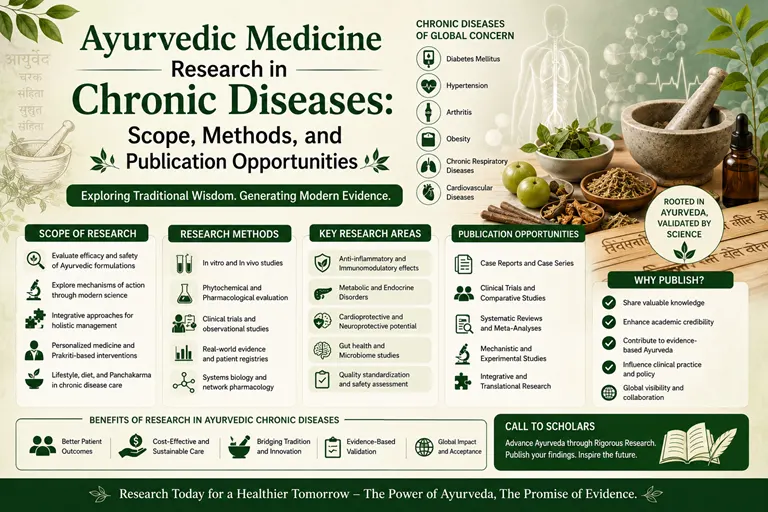
As interest in evidence-based traditional medicine continues to expand, researchers now have unprecedented opportunities to contribute meaningful scientific evidence through high-quality studies in Ayurveda and integrative healthcare.
Why Chronic Disease Research Matters in Ayurveda
Chronic diseases often involve complex interactions among genetic, environmental, behavioral, and psychosocial factors. Conventional treatment approaches frequently focus on symptom control and disease management, while many chronic conditions require long-term lifestyle modifications and holistic interventions.
Ayurveda provides several concepts that are particularly relevant to chronic disease research, including:
- Individualized treatment strategies
- Dietary and lifestyle interventions
- Preventive healthcare approaches
- Long-term disease management
- Personalized medicine concepts
- Holistic patient assessment
These principles align closely with modern healthcare priorities that increasingly emphasize patient-centered and preventive care.
The Growing Burden of Chronic Diseases
The prevalence of chronic diseases continues to increase globally.
Major chronic conditions affecting healthcare systems include:
- Diabetes mellitus
- Obesity
- Hypertension
- Cardiovascular diseases
- Arthritis and musculoskeletal disorders
- Chronic respiratory diseases
- Mental health disorders
- Cancer
- Autoimmune diseases
- Neurodegenerative conditions
The growing burden of these diseases has generated increasing interest in complementary and integrative healthcare approaches that may improve patient outcomes and quality of life.
Why Ayurveda Offers Research Opportunities in Chronic Disease Management
Ayurveda emphasizes maintaining balance through:
- Proper nutrition
- Lifestyle modification
- Preventive interventions
- Mind-body approaches
- Individualized therapies
These principles make Ayurveda highly relevant to modern chronic disease research.
Researchers can investigate:
- Clinical effectiveness
- Quality of life outcomes
- Preventive interventions
- Long-term disease management
- Patient-reported outcomes
- Integrative treatment strategies
Major Research Areas in Chronic Disease Management
Diabetes and Metabolic Disorders
Diabetes remains one of the most extensively studied areas in Ayurvedic medicine.
Potential research topics include:
- Integrative diabetes management
- Lifestyle interventions
- Herbal formulations
- Prevention of complications
- Glycemic control strategies
- Patient adherence and self-care
Obesity and Metabolic Syndrome
Obesity has become a major public health concern.
Research opportunities include:
- Weight management interventions
- Dietary approaches
- Behavioral modifications
- Integrative obesity management
- Metabolic health outcomes
Cardiovascular Diseases
The increasing prevalence of cardiovascular disorders has generated interest in:
- Risk reduction strategies
- Preventive healthcare
- Lifestyle interventions
- Stress management
- Long-term wellness approaches
Arthritis and Musculoskeletal Disorders
Many patients seek integrative approaches for chronic pain and musculoskeletal conditions.
Research opportunities include:
- Quality of life studies
- Functional outcome assessments
- Pain management strategies
- Rehabilitation approaches
- Long-term follow-up studies
Mental Health Disorders
The growing burden of stress-related conditions has created significant opportunities in:
- Anxiety management
- Depression research
- Sleep disorders
- Mind-body interventions
- Wellness and resilience studies
Cancer Supportive Care
Research in integrative oncology continues to expand.
Potential areas include:
- Symptom management
- Quality of life improvement
- Palliative care support
- Nutrition and wellness interventions
- Psychological well-being
Public Health and Preventive Medicine
Ayurveda's strong emphasis on prevention creates numerous opportunities for:
- Community health research
- Lifestyle intervention studies
- Health promotion initiatives
- School health programs
- Workplace wellness studies
- Population-based research
Research Methodologies in Ayurvedic Medicine
The quality of scientific evidence depends significantly on the research methods employed.
Observational Studies
Observational studies are particularly useful for:
- Real-world evidence generation
- Long-term follow-up
- Patient-reported outcomes
- Clinical practice documentation
Clinical Trials
Clinical trials remain essential for evaluating:
- Effectiveness
- Safety
- Comparative interventions
- Integrative treatment approaches
Well-designed clinical trials significantly strengthen the evidence base of Ayurvedic medicine.
Case Reports and Case Series
Case reports are valuable for:
- Reporting rare conditions
- Describing novel interventions
- Generating research hypotheses
- Documenting clinical experiences
Systematic Reviews and Meta-Analyses
These methodologies help:
- Summarize existing evidence
- Identify research gaps
- Inform clinical practice
- Guide future research priorities
Qualitative Research
Qualitative studies can explore:
- Patient experiences
- Treatment perceptions
- Healthcare behaviors
- Cultural perspectives
- Healthcare delivery models
Mixed-Methods Research
Combining quantitative and qualitative approaches often provides a more comprehensive understanding of complex healthcare interventions.
Importance of Standardized Clinical Documentation
Clinical documentation forms the foundation of high-quality research.
Researchers should maintain:
- Patient histories
- Laboratory investigations
- Treatment records
- Follow-up information
- Outcome measures
- Adverse event documentation
Well-documented data significantly improve the quality and credibility of research publications.
Challenges in Ayurvedic Research on Chronic Diseases
Despite considerable opportunities, several challenges remain.
Methodological Complexity
Individualized interventions may complicate study design.
Standardization Issues
Variations in formulations and treatment protocols can affect reproducibility.
Long-Term Follow-Up Requirements
Many chronic disease studies require extended observation periods.
Funding and Resource Limitations
Large-scale studies may require substantial financial and institutional support.
Interdisciplinary Collaboration
Effective research often requires collaboration among:
- Ayurveda scholars
- Clinicians
- Public health experts
- Biostatisticians
- Pharmacologists
- Epidemiologists
Addressing these challenges requires methodological rigor and collaborative research efforts.
Publication Opportunities for Scholars
The growing field of chronic disease research offers numerous publication opportunities.
Researchers can publish:
- Original research articles
- Clinical studies
- Case reports
- Systematic reviews
- Meta-analyses
- Short communications
- Public health studies
- Educational research
- Methodological papers
High-quality publications contribute significantly to the evidence base of Ayurveda and improve international visibility.
How to Improve Publication Success
Researchers can improve their chances of publication by:
- Choosing meaningful research questions
- Using appropriate methodologies
- Following reporting guidelines
- Ensuring ethical compliance
- Maintaining high-quality documentation
- Presenting data transparently
Clear scientific writing and adherence to journal guidelines are equally important.
Emerging Areas for Future Research
Several promising research areas are likely to shape the future of Ayurveda and chronic disease management.
Personalized Medicine and Prakriti Research
Understanding individual variability in health and disease remains a major area of interest.
Digital Health Applications
Technology-assisted monitoring and telehealth interventions are creating new research opportunities.
Artificial Intelligence and Data Science
Advanced analytical methods may help generate new insights from traditional healthcare data.
Biomarker and Translational Research
Integrating traditional concepts with modern biomedical science presents exciting possibilities.
Implementation Science
Research on the practical integration of Ayurveda into healthcare systems is becoming increasingly important.
The Role of Academic Journals in Advancing Evidence-Based Ayurveda
Scholarly journals serve as essential platforms for:
- Scientific communication
- Dissemination of evidence
- Interdisciplinary collaboration
- Professional discussion
- Research visibility
Publishing high-quality research in chronic disease management contributes to the global understanding of Ayurveda and its role in modern healthcare.
A Growing Need for Modern Publishing Infrastructure
As research activity in Ayurvedic medicine increases, journals require efficient systems for managing:
- Manuscript submission
- Peer review
- Editorial workflows
- Metadata management
- DOI integration
- Publication processes
Modern journal platforms such as ScholarJMS provide integrated solutions that simplify scholarly publishing and support journal growth.
Institutions and publishers seeking support for launching or upgrading journals can also obtain assistance through OJSCloud for:
- Journal website development
- ISSN consulting
- OJS migration
- Editorial workflow setup
- Publishing consultation
Journals requiring support for Crossref DOI implementation and metadata workflows can obtain guidance through GetDOI.
WhatsApp: +91 82003 85143
Email: inquiry@ojscloud.com
Frequently Asked Questions
Why is chronic disease research important in Ayurveda?
Chronic diseases represent major global health challenges, and Ayurveda offers holistic approaches that may contribute to prevention, management, and improved quality of life.
What research methods are commonly used in Ayurvedic medicine?
Researchers commonly use observational studies, clinical trials, case reports, systematic reviews, qualitative research, and mixed-methods approaches.
Can Ayurvedic research contribute to integrative healthcare?
Yes. High-quality evidence can support the integration of Ayurveda into patient-centered and multidisciplinary healthcare systems.
What are the major publication opportunities for scholars?
Researchers can publish original studies, reviews, case reports, public health research, and interdisciplinary investigations.
How can young researchers improve publication success?
Strong methodologies, ethical compliance, clear documentation, and adherence to journal guidelines significantly improve publication outcomes.
Conclusion
Research in chronic disease management represents one of the most important and promising areas of contemporary Ayurvedic science.
The increasing burden of non-communicable diseases has created substantial opportunities for scholars to investigate preventive strategies, lifestyle interventions, integrative therapies, and patient-centered approaches that align with the principles of Ayurveda.
By embracing rigorous methodologies, interdisciplinary collaboration, and high-quality clinical documentation, researchers can contribute significantly to the evidence base of traditional medicine and support its growing role in global healthcare.
As evidence-based Ayurveda continues to evolve, high-quality research in chronic diseases will remain essential for advancing scientific understanding, improving patient care, and strengthening the international recognition of Ayurvedic medicine.