



kjamrvpsv@gmail.com
+919447535633
e-ISSN: 3107-4057
logo

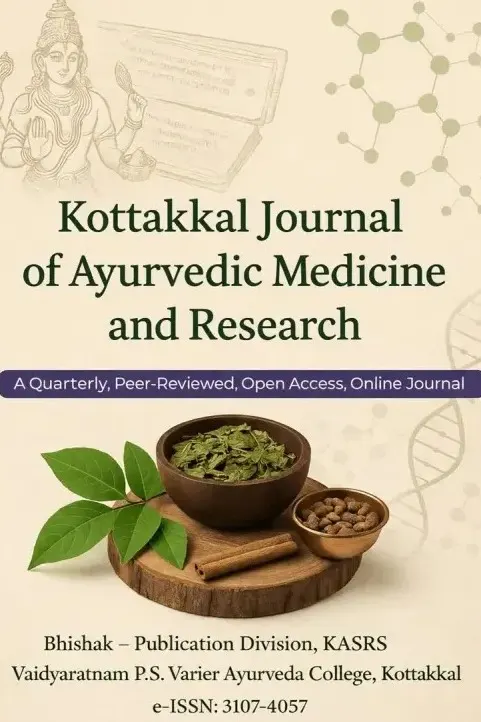
Kottakkal Journal of Ayurvedic Medicine And Research

Kottakkal Journal of Ayurvedic Medicine And Research

Advancing knowledge through rigorous peer-reviewed research across multiple disciplines. Join the global community of scholars shaping the future of academic discovery.

📢 Latest Update: Call for papers for the October–December 2026 issue – Submit by August 31, 2026.

📢 Latest Update: Call for papers for the October–December 2026 issue – Submit by August 31, 2026.

Important Journal Details

Title:
Kottakkal Journal of Ayurvedic Medicine And Research
Journal Short Name:
KJAMR
e-ISSN (Online):
3107-4057
Year of Establishment:
2025
Frequency of the Publication:
Quarterly (4 Issues / year)
Publication Format:
Online
Publication URL:
https://kjamrvpsv.org
Related Subject:
Ayurvedic MedicineResearch
Language:
English
Editor-in-Chief:
Dr. Bindu KK
Editorial Board:
Click Here →
Journal's Email ID:
kjamrvpsv@gmail.com

Download Forms & Formats

Download Hub

Publisher Details

Responsible Person Name:
Sri. Neelakandan A. N.
Name of Publishing body:
Bhishak Publication Division, Kerala Ayurvedic Studies and Research Society
Publisher Website Url:
https://kasrs.org/kasrs/index.php
Address:
Chief Executive Officer, Kerala Ayurvedic Studies and Research Society, Kottakkal, Kerala, 676501

Journal Features

Rigorous Peer Review

All submissions undergo thorough evaluation by experts in the field to ensure quality and validity.

Global Reach

Published papers reach an international audience of researchers, academics, and industry professionals.

Rapid Publication

Efficient review process ensures timely publication of accepted papers without compromising quality.

Open Access

All published papers are freely accessible online, maximizing visibility and impact of your research.

Publication Process

1

Prepare Manuscript

Format your paper according to our guidelines

View Guidelines
style="fill: var(--journal-600);"
2

Submit Paper

Upload your manuscript through our system

Submit Now
3

Peer Review

Your paper undergoes expert evaluation

Learn More
4

Publication

Accepted papers are published worldwide

View Publications
View All Issues
Cover image for Dhatu Poṣaṇa Nyaya: Integrating Ayurvedic Principles of Tissue Nourishment with Modern Physiological Concepts

Dhatu Poṣaṇa Nyaya: Integrating Ayurvedic Principles of Tissue Nourishment with Modern Physiological Concepts

Rajitha M, Dr Hakkeem Panthappulan

Nyaya is defined as an expression of a general truth or principle, and in Ayurveda it serves as an important methodological tool similar to Tantrayukti, Tacchilyam, and Kalpana to elucidate complex concepts through practical analogies and examples. Dhatu Poṣaṇa Nyayas are such explanatory principles employed in Ayurvedic classics and commentaries to clarify the process of formation and nourishment of the Dhatus. Proper nourishment of Dhatus is essential for the maintenance of health and prevention of disease. Classical Ayurvedic texts describe various Dhatuposhana Nyayas such as Ksheera Dadhi Nyaya,Kedari Kulya Nyaya , Khale Kapota Nyaya, and Eka kala dhatu poshana Nyaya to elucidate the process of Dhatu formation and distribution of nutrients in the body, to clarify the mechanisms of tissue development and nutrient allocation within the body. Correlating Dhatu Poṣaṇa Nyaya with contemporary physiological and biochemical knowledge provides a meaningful bridge between classical Ayurvedic wisdom and modern scientific understanding. Such integrative interpretation strengthens the scientific relevance of Ayurveda, facilitates interdisciplinary symposium, and offers a conceptual foundation for translational research, systems biology, and personalised healthcare approaches. This article explores these conceptual frameworks, analysing their theoretical foundations and highlighting their relevance in understanding physiological processes in both classical and contemporary contexts.

Cover image for Ghee: A Delicious Path To Healthy Cholesterol,   Separating Fact From Fiction- A Coneptual Review

Ghee: A Delicious Path To Healthy Cholesterol, Separating Fact From Fiction- A Coneptual Review

Deepika V M, Dr. VIVEK P

Objective: Ghee (clarified butter) holds a vital place in Indian cuisine and Ayurveda, with India being the largest producer and consumer. Containing about 99.5% fat, ghee is rich in MUFA, PUFA, omega fatty acids, cholesterol, and vitamins A, D, E, and K, with its composition varying by milk source. Cow ghee is considered superior due to its favorable qualities and therapeutic value, described in Ayurveda as Sarvaprāninām sāmānyataḥ pathyatamaḥ—wholesome for all. Although often misunderstood as increasing cholesterol or obesity risk, studies reveal that moderate consumption of pure ghee supports lipid balance and overall metabolic health. Data Source: This review integrates classical Ayurvedic literature and modern scientific data on ghee’s composition and physiological effects. References from Charaka Samhita, Sushruta Samhita, and Ashtanga Hridaya emphasize the therapeutic significance of Go-ghrta. Review methods: Contemporary studies and nutrition databases were analyzed to evaluate ghee’s fatty acid profile, cholesterol content, and influence on lipid metabolism and cardiovascular health. Research focusing on moderate ghee intake (up to 10% of daily calories) was compared to align Ayurvedic insights with modern evidence. Conclusion: Findings show that ghee, despite containing cholesterol, aids in maintaining lipid balance and metabolic function. Misconceptions linking ghee with obesity or heart disease are largely unsubstantiated. Modern research confirms that moderate consumption of pure ghee does not adversely affect lipid profiles in healthy individuals. When taken in moderation alongside regular physical activity, ghee enhances metabolic health and remains a nutritious, culturally significant part of a balanced diet.

Cover image for Bridging Tradition and Sustainability: Harnessing Vrikshayurveda Principles in Organic Medicinal Plant Cultivation

Bridging Tradition and Sustainability: Harnessing Vrikshayurveda Principles in Organic Medicinal Plant Cultivation

Thasneem T, Dr.M V Vinodkumar MD(Ay), PhD

Introduction: India holds one of the richest repositories of medicinal plant diversity in the world, with around 7,500 species (44% of its flora) used for therapeutic purposes. The escalating demand has led to unsustainable wild collection practices and poses a serious threat to long-term availability. The cultivation of these plants remains limited due to challenges such as inadequate research, weak infrastructure and policy gaps. There is a pressing need for a sustainable, ecologically responsible model of medicinal plant cultivation. Methods: This paper explores the ancient principles of Vrikshayurveda, an Indian system of plant science, and evaluates its compatibility with modern organic agricultural practices. A qualitative analysis is conducted through literature review and discussions with experts and farmers. Results: The comparative analysis reveals a significant biochemical congruence between Vrikshayurveda formulations (e.g., Kunapajala) and modern organic inputs (e.g., Fish Amino Acid), validated by shared mechanisms of protein hydrolysis and microbial bio-priming. Stakeholder interactions identified economic viability and the 'soil transition period' as key barriers to implementation Conclusion: The integration of Vrikshayurveda and organic methods presents a viable pathway to sustainable medicinal plant cultivation in India. This paper addresses existing challenges, proposes solutions to support scalability, and provides insights into field-level realities and practical aspects of the current organic farming landscape, helping bridge the gap between theory and on-ground implementation. Key words :Vrikshayurveda, sustainable agriculture, medicinal plant cultivation.

Publication Process

Learn about our 4-step publication process

Submission Guidelines

Review requirements before submitting

Submit Article

Ready to submit your research?

42
Published Articles
96
Active Researchers
195
Countries
N/A
Impact Factor