


Current Issue
Volume 2, Issue 4 - 2026 (October-December 2026)
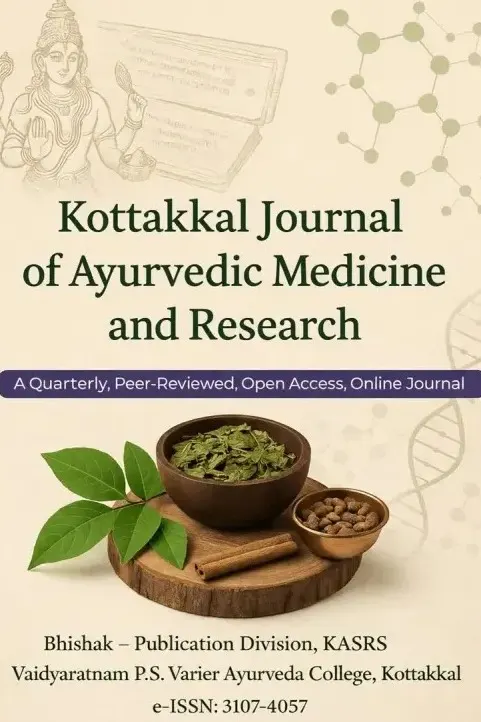
Issue Details:
Volume 2 Issue 4 (October-December 2026)Issue Description:
Welcome to the 2026 issue of Kottakkal Journal of Ayurvedic Medicine And Research. This issue showcases the remarkable breadth and depth of contemporary research across multiple disciplines. From cutting-edge applications of machine learning in climate science to the revolutionary potential of quantum computing in drug discovery, our featured articles demonstrate the power of interdisciplinary collaboration in addressing global challenges.
We are particularly excited to present research that bridges traditional academic boundaries, reflecting our journal's commitment to fostering innovation through cross-disciplinary dialogue. The integration of artificial intelligence with environmental science, the application of blockchain technology to supply chain management, and the convergence of urban planning with smart city technologies exemplify the transformative potential of collaborative research.
As we continue to navigate an era of rapid technological advancement and global challenges, the research presented in this issue offers both insights and solutions that will shape our future. We thank our authors, reviewers, and editorial board members for their continued dedication to advancing knowledge and promoting scientific excellence.
Dr. Bindu KK
Editor-in-Chief
Kottakkal Journal of Ayurvedic Medicine And Research
Articles in This Issue
 Open Access
Crossing the Subtle Barrier: An Ayurvedic Perspective on Brain Transport Mechanisms
The blood–brain barrier (BBB) restricts the entry of large and hydrophilic molecules, thereby limiting effective drug delivery to the brain. Contemporary approaches to overcome this challenge include selective transport strategies, nanoparticle-based systems, and non-invasive routes such as intranasal administration. Classical Ayurveda presents conceptual parallels through the doctrines of Doṣhas, Srotas, and Nyāyas, including Kedāra-Kuḷya Nyāya and Khale-Kapota Nyāya, which describe the distribution of nutrients and tissue-specific targeting. Lipid-based formulations such as Ghṛta and Medhya Rasāyanas correspond with the lipid-rich architecture of neural tissue, suggesting a rational basis for their neurological applications. However, the precise mechanisms by which these formulations influence BBB dynamics remain inadequately explored. This review integrates classical Ayurvedic principles with contemporary insights into BBB biology to elucidate potential correlations in structure and transport mechanisms. Primary sources included the Bṛhattrayī, authoritative commentaries, and the Ayurvedic Pharmacopoeia of India, while relevant peer-reviewed literature from PubMed, Scopus, and Google Scholar was analyzed to bridge traditional constructs with modern evidence. Conceptual parallels were identified between Srotas and microvascular networks, Paramāṇu and molecular dimensions, and Nyāyas and passive or active transport phenomena. Descriptions of Sūkṣma and Sthūla Srotas reflect size-dependent permeability and endothelial regulation. Functional analogies were observed between Vyāna Vāyu and neural perfusion, Tarpaka Kapha and cerebral nourishment, and Prāṇa Vāyu and respiratory exchange. Additionally, Nasya demonstrates correspondence with intranasal delivery pathways that partially bypass the BBB. These convergences suggest that Ayurvedic microstructural theory may provide a complementary interpretative framework for understanding BBB physiology and targeted brain drug delivery.
Contributors:
Open AccessBeyond the Oral Route: A Comprehensive Review on Trans-Mucosal and Target-Specific Drug Delivery in Classical Visha Chikitsa
The blood–brain barrier (BBB) is a highly selective component of the neurovascular unit that regulates the movement of substances between the systemic circulation and the central nervous system. Contemporary strategies for brain delivery include passive diffusion, carrier-mediated transport, receptor-mediated transcytosis, nanoparticle-based approaches, and intranasal delivery. Ayurveda describes nourishment, distribution, and movement within the body through concepts such as Doshas, Srotas, Agni, and Nyayas including Kedara-Kulya and Khale-Kapota. This narrative, integrative review examines these classical concepts alongside contemporary understanding of BBB structure and transport mechanisms, with the aim of developing a cautious interdisciplinary interpretative framework. Classical Ayurvedic sources and selected scientific literature were examined to identify conceptual correspondences, evidence gaps, and potential areas for future research. The review distinguishes classical descriptions from modern interpretations and hypothesis-generating analogies. Srotas may be considered a functional concept related to movement and distribution, while comparisons with specific vascular structures, cellular components, molecular dimensions, or membrane transport mechanisms remain interpretative rather than established equivalences. Similarly, the lipid-rich nature of Ghrita and the absorption of lipid-associated phytoconstituents may influence formulation-dependent solubilization, systemic absorption, and pharmacokinetics; however, these properties alone do not demonstrate BBB penetration or central nervous system exposure. Nasya may be interpreted in relation to contemporary intranasal drug-delivery pathways, whereas proposed mechanisms of Sirodhara involving central neurophysiological effects require further investigation. Thus, this framework identifies testable points of correspondence without claiming direct equivalence between Ayurvedic concepts and modern BBB mechanisms.
Contributors:
Open AccessA Case Report on the Ayurvedic Management of Pemphigus Foliaceus through Visha Chikitsa: A Clinical Approach Based on Kardama Visarpa
Pemphigus is a life- threatening autoimmune blistering disease formed due to circulating antibodies like IgG against desmoglein. Pemphigus foliaceous (PF) is a subtype of pemphigus, in which only skin is affected with characteristic features of widespread blisters and crusted lesions all over the body. The signs and symptoms of Kardama visarpa mentioned in Ayurveda classics resembles the clinical features of PF. The present case is aimed to treat a male patient diagnosed with PF admitted in the IP department of Agadatantra in VPSV Ayurveda College Kottakkal. The aim of the treatment was to control the progression and reduce the current clinical condition through the concepts of Visha chikitsa as the condition was triggered due to continuous usage of hair dye to which the patient was allergic. PDAI score is used in this study as assessment tool for PF.
Contributors:
Open AccessZebrafish Models in Rasayana Pharmacology and Ayurgenomics: A Scoping Review of Translational Evidence
Background: Ayurveda prioritises individualised healthcare through Prakriti (constitutional phenotype) assessment and rejuvenation through Rasayana therapy. The emerging discipline of Ayurgenomics aims to correlate these traditional concepts with molecular and genomic frameworks. Despite this, there is a scarcity of experimentally tractable models for validating these principles. Zebrafish (Danio rerio) have become prominent in translational research because of their genetic similarity to humans, optical transparency, rapid development, and compatibility with high-throughput and multi-omics methodologies. Materials and Methods: The scoping review was conducted in accordance with the Arksey and O’Malley framework and PRISMA-ScR guidelines. Electronic searches of PubMed, Scopus, Web of Science, MEDLINE, ScienceDirect, and Google Scholar were conducted for literature published up to December 2025 using terms related to zebrafish/Danio rerio, Ayurveda, Rasayana, Ayurgenomics, and traditional herbal medicines. Two reviewers independently screened titles/abstracts and full texts using predefined eligibility criteria. Of 1,245 records identified, 150 studies met the inclusion criteria. Results: The evidence indicates that zebrafish effectively model developmental toxicity, organ-specific and molecular responses, modulation of oxidative stress, neurobehavioral alterations, metabolic regulation, and tissue regeneration. High-throughput embryo assays and disease-specific models facilitate mechanistic validation of herbal interventions. Nevertheless, the integration of Prakriti-based stratification and constitution-specific frameworks is limited, as most studies focus on isolated compounds rather than polyherbal or personalised approaches. Conclusion: Zebrafish constitute a robust yet underutilised translational platform for advancing evidence-based Rasayana research and Ayurgenomics. The integration of multi-omics tools, standardised protocols, and constitution-oriented experimental designs has the potential to enhance precision-based Ayurvedic therapeutics and facilitate the integration of traditional knowledge with contemporary biomedical science.
Contributors:
Open AccessPatient compliance, Acceptability & Clinical implications of Kashaya
Objective: To assess variations in the preparation, administration, storage, dosage, and usage practices of Kashaya among outpatient participants. Methodology: An observational cross-sectional survey was conducted among 81 outpatients receiving Kashaya from VPSV Ayurveda College Hospital, Kottakkal, from June 22–27, 2026. Data were collected using a semi-structured questionnaire covering duration of use, indications, frequency, preparation and storage practices, preferred dosage forms, use of Prakshepa, concomitant medications, time of administration, and dosage. Results: Considerable variations were observed in Kashaya preparation, storage, dosage, duration, and administration practices. Some participants stored prepared Kashaya for several days. A minority discontinued Kashaya due to gastric discomfort or aggravation of symptoms. Variations were also observed in the number of Kashaya consumed daily, use of Prakshepa, and maintenance of time gaps between Kashaya and concomitant medications. Conclusion: The findings highlight variations between classical principles of Kashaya administration and contemporary patient practices. Standardization of preparation, dosage, and storage practices is essential for ensuring consistency and therapeutic efficacy. Appropriate guidance regarding administration and time gaps between Kashaya and concomitant medications may promote safer use.
Contributors:
Open AccessA Scoping review on the role of modern investigations in current Ayurvedic clinical practice
Background: Ayurveda, a time-tested branch of medicine, is gaining global recognition. However, the integration of modern diagnostic tools into Ayurvedic clinical practice has become essential in the current AI-driven healthcare system. Modern investigations provide objective validation for Ayurvedic principles and facilitate the incorporation of Ayurveda into mainstream health systems. Objectives: To evaluate the role and relevance of modern diagnostic investigations in current Ayurvedic medical practice, highlighting their benefits, limitations, and the importance of maintaining classical Ayurvedic diagnostic frameworks. Methods: A scoping review of 43 published articles from 3 databases over the last 10 years was conducted to assess how modern investigations are utilized in Ayurvedic clinical settings. The articles were analyzed for the types of investigations used, their purpose, such as diagnosis, prognosis, health assessment, treatment efficacy, and safety, and their contribution to Ayurvedic practice. A structured analysis was also performed to identify disease-wise and purpose-wise use of investigations. Results: The majority of studies demonstrated the use of biochemical, imaging, and haematological investigations alongside Ayurvedic treatments. Diseases like yoniroga and liver disorders had the highest number of studies. Most investigations were employed for diagnosis and treatment efficacy, while few were used for safety assessments. Integration of diagnostic tools such as USG, CT, MRI, HbA1c, and LFTs enhanced clinical decision-making but often lacked alignment with Ayurvedic assessments like Daśavidha and Aṣṭavidha Parīkṣa. Conclusion: Modern diagnostic tools, when used judiciously, serve as a valuable integration to Ayurvedic clinical practice. They aid in accurate diagnosis, monitoring treatment efficacy, and ensuring patient safety. However, overdependence on these tools may affect the holistic principles of Ayurveda. A balanced approach integrating both modern diagnostics and classical Ayurvedic assessments is essential for the evolution of Ayurveda in contemporary medicine.