


Evidence-Based Ayurveda Research: Why Clinical Documentation Matters in Modern Ayurvedic Practice
Evidence-Based Ayurveda Research: Why Clinical Documentation Matters in Modern Ayurvedic Practice
Ayurveda is among the world's oldest systems of medicine, with a rich heritage of clinical wisdom, individualized treatment approaches, and holistic healthcare principles. Over the past few decades, global interest in Ayurveda has grown substantially as researchers and healthcare professionals increasingly recognize the importance of preventive medicine, lifestyle interventions, and patient-centered care.
However, one important question continues to arise in scientific and healthcare communities:
How can the effectiveness and clinical value of Ayurvedic interventions be systematically demonstrated and communicated?
The answer lies largely in high-quality clinical documentation and evidence generation.
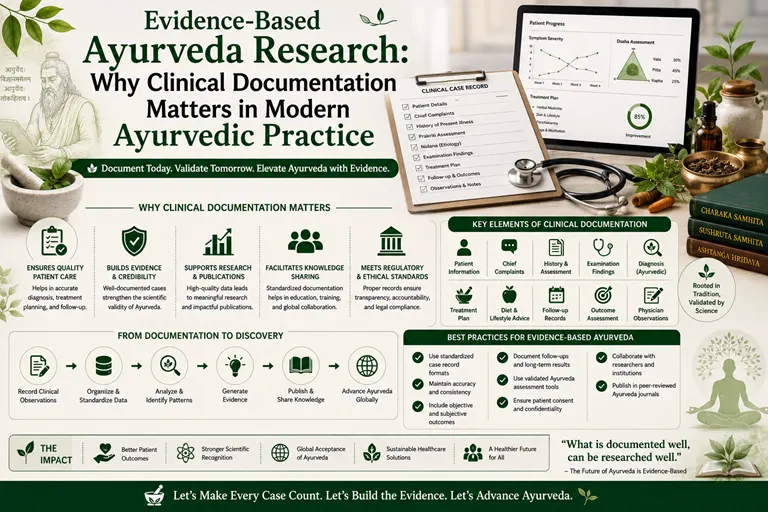
Modern healthcare increasingly relies on evidence-based practice. While Ayurveda possesses thousands of years of experiential knowledge, the future growth and international acceptance of Ayurvedic medicine depend significantly on the ability to document, analyze, and publish clinical experiences using rigorous scientific methods.
Clinical documentation is therefore not merely an administrative task. It is the foundation upon which evidence-based Ayurveda can continue to grow and gain global recognition.
What is Evidence-Based Ayurveda?
Evidence-based Ayurveda refers to the integration of:
- Classical Ayurvedic knowledge
- Clinical expertise
- Scientific research evidence
- Patient preferences and outcomes
The objective is not to replace traditional knowledge with modern science, but rather to strengthen and validate clinical experiences through systematic observation and documentation.
Evidence-based approaches help:
- Improve clinical decision-making
- Enhance patient care
- Support scientific communication
- Strengthen credibility
- Encourage interdisciplinary collaboration
Why Evidence Matters in Modern Healthcare
Healthcare systems across the world increasingly rely on data-driven decision-making.
Researchers, clinicians, policymakers, and patients often seek evidence regarding:
- Safety
- Effectiveness
- Clinical outcomes
- Quality of life improvements
- Long-term benefits
- Comparative effectiveness
Without adequate documentation, valuable clinical experiences remain inaccessible to the wider scientific community.
This creates a significant gap between traditional clinical practice and scientific communication.
The Unique Strength of Ayurveda
Ayurveda possesses several characteristics that make it particularly valuable for modern healthcare research.
These include:
- Personalized treatment approaches
- Holistic patient assessment
- Preventive healthcare strategies
- Lifestyle interventions
- Long-term disease management
- Mind-body integration
However, these strengths can only be adequately appreciated internationally when they are supported by high-quality evidence and well-documented clinical observations.
Why Clinical Documentation Matters
Clinical documentation refers to the systematic recording of:
- Patient information
- Medical history
- Clinical findings
- Ayurvedic assessment
- Treatment interventions
- Follow-up outcomes
- Adverse events
- Patient-reported experiences
Proper documentation transforms routine clinical practice into valuable scientific evidence.
Benefits of Clinical Documentation in Ayurveda
Supports Evidence Generation
Clinical documentation forms the basis for:
- Case reports
- Case series
- Observational studies
- Clinical trials
- Systematic reviews
Without accurate records, meaningful research becomes extremely difficult.
Improves Patient Care
Detailed records allow practitioners to:
- Monitor treatment progress
- Evaluate outcomes
- Adjust therapeutic interventions
- Improve long-term management strategies
Enhances Professional Credibility
Well-documented evidence improves confidence among:
- Researchers
- Healthcare professionals
- Policymakers
- Patients
- Academic institutions
Facilitates Publication
Most scholarly publications require:
- Detailed patient information
- Follow-up data
- Outcome measurements
- Ethical documentation
Good documentation significantly improves publication opportunities.
Why Many Valuable Clinical Experiences Remain Unpublished
Ayurvedic practitioners often encounter remarkable clinical outcomes in daily practice.
Unfortunately, many of these experiences are never published because:
- Records are incomplete.
- Follow-up information is unavailable.
- Treatment details are missing.
- Outcome measures are not documented.
- Data collection is inconsistent.
As a result, valuable clinical evidence is frequently lost.
Essential Components of Clinical Documentation
Patient Demographics
Documentation should include:
- Age
- Gender
- Occupation
- Relevant medical history
Personal identifiers should remain confidential.
Presenting Complaints
Clear documentation of:
- Symptoms
- Duration
- Severity
- Previous treatments
Clinical Examination
Include:
- Physical examination findings
- Laboratory investigations
- Diagnostic reports
- Relevant observations
Ayurvedic Assessment
This is particularly important in Ayurvedic practice.
Documentation should include:
- Prakriti
- Dosha involvement
- Dushya
- Srotas
- Samprapti
- Nidana
- Ayurvedic diagnosis
Therapeutic Intervention
Detailed information should be recorded regarding:
- Medicines prescribed
- Dosages
- Duration
- Panchakarma procedures
- Dietary advice
- Lifestyle recommendations
Follow-Up and Outcomes
Outcome measures should include:
- Symptom improvement
- Clinical findings
- Laboratory parameters
- Patient satisfaction
- Quality of life indicators
Adverse Events
Documentation should also include:
- Side effects
- Unexpected reactions
- Treatment modifications
Transparent reporting strengthens scientific credibility.
Clinical Documentation and Evidence Hierarchy
Different forms of evidence depend heavily on clinical documentation.
Case Reports
Single-patient observations often generate new hypotheses.
Case Series
Multiple similar cases can identify emerging patterns.
Observational Studies
Longitudinal documentation provides real-world evidence.
Clinical Trials
Rigorous documentation forms the foundation of controlled investigations.
Systematic Reviews and Meta-Analyses
Published evidence eventually contributes to broader scientific understanding.
Thus, every well-documented patient encounter has the potential to contribute to the scientific advancement of Ayurveda.
Importance of Standardized Documentation
Standardization improves:
- Reproducibility
- Data quality
- Research comparability
- Publication potential
Practitioners and researchers should adopt consistent methods for recording:
- Clinical findings
- Treatment interventions
- Outcome measures
- Follow-up information
Standardized documentation also facilitates multicenter research and collaborative studies.
Clinical Documentation in Chronic Diseases
Chronic diseases represent one of the most important research areas in Ayurveda.
Conditions frequently encountered include:
- Diabetes mellitus
- Obesity
- Arthritis
- Hypertension
- Autoimmune disorders
- Neurological conditions
- Mental health disorders
Because these conditions often require long-term management, they provide valuable opportunities for generating real-world evidence through systematic documentation.
Clinical Documentation and Integrative Healthcare Research
Integrative healthcare increasingly values:
- Patient-centered outcomes
- Long-term effectiveness
- Quality of life measures
- Personalized treatment approaches
Ayurvedic practitioners who maintain high-quality clinical records can contribute significantly to interdisciplinary and integrative healthcare research.
Ethical Considerations in Documentation
Ethics should always remain a priority.
Researchers and clinicians should ensure:
- Patient confidentiality
- Informed consent
- Secure record management
- Responsible publication practices
Ethical documentation strengthens both scientific credibility and public trust.
Common Documentation Mistakes
Several common issues limit publication opportunities.
Incomplete Patient Histories
Missing information reduces scientific value.
Insufficient Follow-Up
Without follow-up, long-term outcomes cannot be evaluated.
Lack of Objective Evidence
Clinical observations should be supported by measurable outcomes whenever possible.
Missing Treatment Details
Incomplete intervention information limits reproducibility.
Inconsistent Record Keeping
Poor organization often leads to loss of valuable information.
How Clinical Documentation Supports Publication
High-quality records allow practitioners and researchers to develop:
- Case reports
- Case series
- Original research articles
- Observational studies
- Review articles
Proper documentation also facilitates collaboration among institutions and researchers.
Building a Culture of Evidence-Based Ayurveda
The future of Ayurvedic medicine depends not only on preserving traditional knowledge but also on generating robust scientific evidence.
Developing a culture of documentation can:
- Strengthen research quality
- Improve publication output
- Encourage scientific collaboration
- Enhance international recognition
- Support evidence-based healthcare integration
Every practitioner has the potential to contribute to this evidence ecosystem.
The Role of Academic Journals in Evidence Generation
Scholarly journals play an important role in:
- Disseminating clinical evidence
- Encouraging documentation
- Promoting research methodologies
- Supporting scientific communication
- Preserving valuable clinical experiences
Journals dedicated to Ayurvedic medicine provide essential platforms for sharing evidence that can influence future research and clinical practice.
A Growing Need for Efficient Research and Publishing Infrastructure
As Ayurvedic research activity expands, journals increasingly require efficient systems for managing:
- Manuscript submission
- Peer review
- Editorial workflows
- Metadata management
- DOI integration
- Publication processes
Modern journal platforms such as ScholarJMS provide integrated solutions that support scholarly publishing and research dissemination.
Institutions and journal publishers seeking support for launching or upgrading journals can also obtain assistance through OJSCloud for:
- Journal website development
- ISSN consulting
- OJS migration
- Editorial workflow setup
- Publishing consultation
Journals requiring support for Crossref DOI implementation and metadata workflows can obtain guidance through GetDOI.
WhatsApp: +91 82003 85143
Email: inquiry@ojscloud.com
Frequently Asked Questions
What is evidence-based Ayurveda?
Evidence-based Ayurveda integrates classical Ayurvedic knowledge, clinical expertise, and scientific evidence to improve patient care and support research.
Why is clinical documentation important?
Clinical documentation provides the data necessary for evidence generation, research publications, and improved patient management.
Can clinical records lead to publications?
Yes. Well-maintained clinical records often become the foundation for case reports, observational studies, and original research articles.
What information should be documented in Ayurvedic practice?
Patient history, diagnosis, treatment details, follow-up data, outcome measures, and adverse events should all be documented systematically.
How can practitioners contribute to evidence generation?
By maintaining accurate records, participating in research, and publishing meaningful clinical experiences.
Conclusion
Clinical documentation is one of the most important foundations of evidence-based Ayurveda.
Every patient encounter presents an opportunity to generate meaningful scientific knowledge that can contribute to better healthcare, improved understanding of traditional medicine, and stronger integration of Ayurveda into modern medical research.
By systematically documenting clinical observations, maintaining ethical standards, and sharing evidence through scholarly publication, practitioners and researchers can play a crucial role in strengthening the scientific credibility and global recognition of Ayurveda.
As evidence-based healthcare continues to evolve, high-quality clinical documentation will remain essential for ensuring that the rich clinical wisdom of Ayurveda contributes meaningfully to future research, education, and patient care.