


How to Get ISSN and Crossref DOI for a New Ayurvedic Medicine Journal
How to Get ISSN and Crossref DOI for a New Ayurvedic Medicine Journal
The global interest in Ayurveda and integrative medicine continues to grow rapidly. Research on traditional medicine, herbal formulations, Panchakarma, preventive healthcare, and evidence-based Ayurveda is receiving increasing academic attention worldwide. Institutions, Ayurveda colleges, professional associations, and independent scholarly societies are therefore launching new journals to create platforms for high-quality research dissemination.
However, starting a scholarly journal involves much more than creating a website and publishing articles.
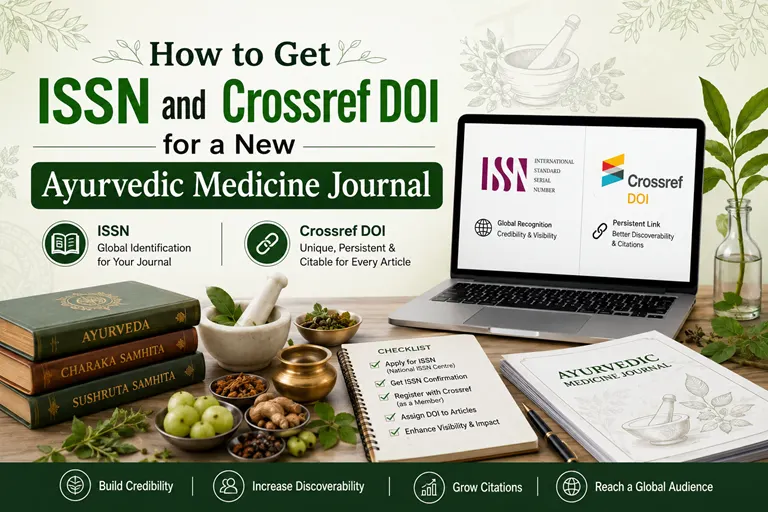
Two of the most important milestones for any new journal are obtaining an ISSN and implementing Crossref DOI registration.
Without these foundational elements, journals often face challenges related to credibility, discoverability, indexing readiness, and long-term sustainability.
This guide explains how new Ayurvedic medicine journals can obtain an ISSN and Crossref DOI while building a strong publishing infrastructure from the beginning.
Why ISSN and DOI Matter for Ayurvedic Medicine Journals
Modern scholarly communication relies heavily on standardized identifiers.
An ISSN and DOI help journals:
- Establish professional credibility
- Improve discoverability
- Support indexing applications
- Facilitate citation tracking
- Enhance metadata quality
- Build trust among authors and readers
- Strengthen long-term digital preservation
As evidence-based Ayurveda gains international recognition, professional publishing standards become increasingly important for journal growth and global visibility.
What is an ISSN?
ISSN stands for International Standard Serial Number.
It is an eight-digit identifier assigned to serial publications, including:
- Scholarly journals
- Magazines
- Continuing publications
- Electronic journals
An online journal typically receives an e-ISSN, while a print edition may receive a separate print ISSN.
An ISSN does not indicate journal quality or indexing status. Instead, it serves as a unique international identifier that distinguishes one serial publication from another.
Why Every New Ayurvedic Journal Needs an ISSN
An ISSN is often required for:
- Journal credibility
- Library cataloguing
- Metadata management
- Citation systems
- Indexing applications
- Institutional recognition
- Long-term journal identity
Many indexing services and journal directories also expect journals to have an ISSN before considering inclusion.
What Do You Need Before Applying for an ISSN?
Many new journals apply for an ISSN too early and receive requests for corrections or additional information.
Before applying, your journal should ideally have:
A Functional Journal Website
The website should include:
- Journal homepage
- About the Journal
- Aims and Scope
- Editorial Board
- Author Guidelines
- Publication Ethics
- Privacy Policy
- Contact Information
- Archive structure
- Manuscript submission system
Clear Publication Policies
Your website should clearly explain:
- Peer review process
- Publication frequency
- Open access policy
- Copyright information
- Ethics statement
- Plagiarism policy
An Identifiable Editorial Team
The editorial board should include:
- Editor-in-Chief
- Associate Editors
- Editorial Board Members
- Institutional affiliations
Defined Scope and Objectives
For Ayurvedic medicine journals, the scope may include:
- Ayurvedic clinical research
- Panchakarma studies
- Medicinal plant research
- Integrative medicine
- Pharmacognosy
- Public health and preventive medicine
- Traditional medicine education
- Evidence-based Ayurveda
Step-by-Step Process to Obtain an ISSN
Step 1: Prepare the Journal Website
A professionally designed journal website significantly improves ISSN readiness.
Your website should demonstrate that the journal is a genuine continuing publication and not simply a concept under development.
Step 2: Finalize Publication Information
Prepare information regarding:
- Journal title
- Publisher name
- Publication frequency
- Editorial office address
- Website URL
- Subject discipline
- Language of publication
Step 3: Submit the ISSN Application
The application is generally submitted to the appropriate national ISSN centre according to the publisher's country.
Different countries may have different requirements and supporting documentation.
Step 4: Respond to Queries
Some applications require additional information or website modifications before approval.
Once approved, the journal receives its ISSN assignment.
Common ISSN Mistakes Made by New Journals
Many new publishers make avoidable mistakes, including:
- Incomplete websites
- Missing editorial policies
- Unclear journal scope
- No publication ethics page
- Insufficient contact information
- Lack of editorial transparency
- Inadequate archive structure
Addressing these issues before submission significantly improves the chances of successful ISSN approval.
Why Professional ISSN Consulting Can Save Time
Launching an academic journal involves many technical and administrative requirements.
Professional consulting can help journals:
- Prepare ISSN-ready websites
- Review publication policies
- Improve editorial structure
- Ensure compliance with publishing standards
- Avoid unnecessary delays
OJSCloud provides consulting services for journal website readiness, ISSN preparation, and journal launch support for new and emerging scholarly journals.
Need Help Obtaining an ISSN for Your Journal?
We can help with:
- Journal website setup
- ISSN consulting
- Publication policy preparation
- Editorial workflow planning
- Journal launch guidance
- Website readiness review
WhatsApp: +91 82003 85143
Email: inquiry@ojscloud.com
What is a Crossref DOI?
DOI stands for Digital Object Identifier.
A DOI provides a permanent and persistent identifier for scholarly content.
Examples include:
- Journal articles
- Review papers
- Editorials
- Conference proceedings
- Supplementary files
DOIs are extremely important because they ensure that scholarly articles remain discoverable even if website URLs change.
Why Ayurvedic Medicine Journals Need DOI Registration
DOIs provide numerous advantages:
- Permanent article identification
- Improved citation tracking
- Better metadata distribution
- Easier indexing integration
- Enhanced discoverability
- Greater author confidence
- Professional journal reputation
As Ayurveda research becomes increasingly global, DOI implementation has become an essential component of professional publishing infrastructure.
When Should a Journal Plan for DOI Registration?
Ideally, DOI planning should begin before the first issue is published.
Many journals delay DOI implementation and later encounter difficulties with:
- Metadata correction
- Retrospective registration
- Workflow redesign
- Citation inconsistencies
Planning early helps establish a scalable publishing workflow.
How Does Crossref DOI Registration Work?
The process generally involves:
Step 1: Establish Publishing Infrastructure
The journal should have:
- Functional website
- Article pages
- Metadata structure
- Publication policies
- Editorial workflow
Step 2: Determine DOI Management Strategy
The journal must decide:
- DOI prefix management
- Metadata deposit process
- Ongoing maintenance responsibilities
Step 3: Deposit Article Metadata
Metadata typically includes:
- Article title
- Author information
- Abstract
- Keywords
- Publication date
- URLs
- References
Step 4: Assign DOIs to Articles
Each article receives a unique DOI that remains permanently associated with the publication.
Why Metadata Quality Matters
DOIs are not simply identification numbers.
The value of DOI implementation depends heavily on metadata quality.
Accurate metadata supports:
- Search engine visibility
- Citation services
- Scholarly databases
- Reference linking
- Research discoverability
Poor metadata management can reduce the benefits of DOI implementation.
How GetDOI Helps New Journals
Many new journals do not have in-house expertise regarding DOI workflows.
GetDOI provides guidance for:
- Crossref DOI setup
- DOI workflow planning
- Metadata preparation
- DOI implementation strategy
- Publishing consultation
- Long-term DOI management
For emerging Ayurvedic medicine journals, professional guidance can significantly simplify the process.
Building the Right Publishing Infrastructure from the Beginning
Obtaining an ISSN and DOI should not be viewed as isolated tasks.
Successful journals also require:
- Professional journal websites
- Manuscript submission systems
- Editorial workflow management
- Publishing policies
- Metadata standards
- Long-term scalability
A comprehensive journal management platform can help publishers establish all of these elements efficiently.
ScholarJMS provides integrated solutions that combine:
- Journal website development
- Manuscript submission
- Editorial workflow management
- Publishing infrastructure
- Article management
- Production support
Why Emerging Ayurvedic Journals Need Strong Digital Foundations
Ayurveda has become one of the most recognized traditional systems of medicine globally, with institutions such as the historic Ayurvedic centres of Kottakkal contributing significantly to the propagation, research, and education of Ayurveda.
As research output increases, journals need professional publishing systems that can:
- Attract quality submissions
- Improve international visibility
- Support indexing readiness
- Strengthen research integrity
- Build long-term credibility
ISSN and DOI implementation form an essential part of this foundation.
Need Help Launching or Upgrading Your Journal?
We can assist with:
- New journal website development
- ScholarJMS implementation
- OJS migration
- ISSN consulting
- Crossref DOI support
- Editorial workflow setup
- Journal launch consulting
WhatsApp: +91 82003 85143
Email: inquiry@ojscloud.com
Frequently Asked Questions
Can a journal obtain an ISSN before publishing its first issue?
Yes. Many countries allow new online journals to obtain an ISSN before publication, provided the website and journal information meet the required standards.
Is an ISSN mandatory for DOI registration?
Not always, but having an ISSN significantly strengthens a journal's professional credibility and publishing infrastructure.
Should every article receive a DOI?
Yes. Assigning a DOI to every scholarly article is considered a best practice in academic publishing.
Can journals apply for DOI registration after publication?
Yes, but early planning generally results in a more efficient workflow and better metadata management.
Do Ayurvedic journals need professional publishing consultation?
Many new journals benefit from professional guidance because journal launch processes involve website development, policies, metadata, DOI workflows, and editorial infrastructure.
Conclusion
Launching a new Ayurvedic medicine journal is an exciting opportunity to contribute to the advancement of evidence-based traditional medicine and integrative healthcare research.
However, building a credible scholarly journal requires strong publishing foundations.
Obtaining an ISSN establishes the journal's formal identity, while Crossref DOI implementation ensures long-term discoverability and citation tracking.
By planning these elements early and developing a professional publishing infrastructure, new Ayurvedic medicine journals can position themselves for sustainable growth and international recognition.
If you are planning to launch a new journal or upgrade an existing publication, obtaining expert guidance on ISSN readiness, DOI workflows, and journal management systems can save considerable time and help avoid common challenges.