


How to Migrate an OJS Ayurvedic Journal to a Modern Journal Management Platform
How to Migrate an OJS Ayurvedic Journal to a Modern Journal Management Platform
The field of Ayurvedic medicine is experiencing remarkable growth in research output and scholarly publishing. Journals dedicated to Ayurveda, integrative medicine, medicinal plants, pharmacognosy, Panchakarma, and traditional healthcare are increasingly attracting submissions from researchers around the world.
Many of these journals initially adopted Open Journal Systems (OJS) because it provided an accessible and open-source solution for online publishing. However, as journals grow and editorial expectations evolve, many publishers begin to encounter challenges that encourage them to consider migration to a more modern journal management platform.
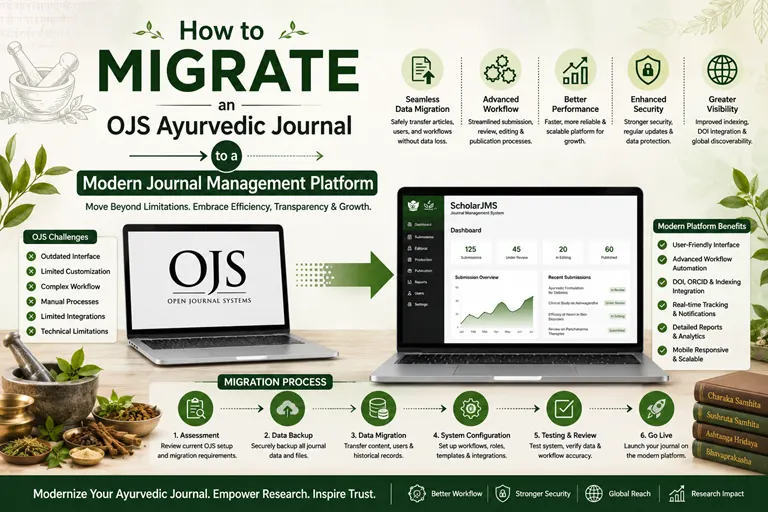
Migrating a journal website is a significant decision. Editors often worry about losing articles, breaking DOI links, damaging search engine rankings, or disrupting the author experience.
Fortunately, with proper planning and professional support, migration can be carried out smoothly and securely.
This guide explains how Ayurvedic medicine journals can successfully migrate from OJS to a modern journal management platform while preserving their content, metadata, and scholarly reputation.
Why Do Ayurvedic Journals Consider Migrating from OJS?
OJS has served the academic community for many years and remains a valuable platform. However, many growing journals face operational challenges that become increasingly difficult to manage.
Common reasons for migration include:
- Technical maintenance requirements
- Outdated user interfaces
- Complex administrative workflows
- Difficulty managing upgrades
- Security concerns
- Limited technical support
- Increasing server management responsibilities
- Need for modern publishing features
As journals mature, editors often prefer to focus on scientific quality and journal development rather than software administration.
Signs That Your Journal May Need Migration
Not every journal requires migration. However, several indicators suggest that a transition may be beneficial.
Frequent Technical Problems
If your editorial team regularly experiences:
- Website downtime
- Plugin conflicts
- Upgrade failures
- Server errors
it may be time to evaluate alternative solutions.
Author Submission Difficulties
Authors increasingly expect modern and intuitive submission systems.
Complicated submission workflows can lead to:
- Abandoned submissions
- Increased support requests
- Negative author experiences
Excessive Administrative Work
Editors should spend their time improving publication quality rather than troubleshooting software.
If technical tasks consume substantial editorial time, migration may provide long-term benefits.
Limited Scalability
Growing journals often need:
- Better workflow automation
- Improved production management
- Enhanced reporting capabilities
- Greater flexibility for expansion
Modern platforms are frequently designed with these needs in mind.
Benefits of Migrating to a Modern Journal Management Platform
Migration can provide several strategic advantages.
Improved User Experience
Modern interfaces simplify:
- Author registration
- Manuscript submission
- Editorial management
- Reviewer communication
Reduced Technical Burden
Managed platforms reduce the need for:
- Server administration
- Plugin maintenance
- Security updates
- Software troubleshooting
Better Editorial Workflows
Automation helps streamline:
- Reviewer invitations
- Reminder emails
- Decision tracking
- Production workflows
Professional Journal Presentation
Modern platforms often provide:
- Responsive website design
- Better article presentation
- Improved navigation
- Enhanced discoverability
Greater Long-Term Sustainability
A professionally managed system allows journals to focus on growth and quality improvement.
What Should Be Migrated from OJS?
A journal migration project involves much more than transferring website files.
Important components include:
- Published articles
- Journal issues
- Article metadata
- Author records
- Editorial information
- Reviewer data
- DOI information
- PDF files
- Supplementary files
- Policies and guidelines
- Website pages
- Search engine structures
A comprehensive migration strategy should ensure that all essential information is preserved.
Step 1: Perform a Migration Assessment
Before migration begins, the journal should conduct a detailed review of its existing website.
Questions to consider include:
- How many issues have been published?
- How many articles exist?
- Are DOIs already assigned?
- Are there supplementary files?
- Are multiple languages used?
- Are there active submissions in progress?
A proper assessment helps define the migration scope and avoid unexpected complications.
Step 2: Create Complete Data Backups
Backups are essential.
The journal should preserve:
- Database backups
- Article files
- Images
- PDF documents
- Metadata exports
- Server configurations
Comprehensive backups ensure that information can be restored if necessary.
Step 3: Plan the New Journal Infrastructure
Migration is also an opportunity to improve the journal's digital infrastructure.
The new platform should support:
- Professional journal websites
- Manuscript submission
- Editorial workflows
- DOI management
- Metadata standards
- Long-term scalability
- Mobile responsiveness
Many journals use migration as an opportunity to modernize their publishing operations.
Step 4: Preserve DOI Integrity
DOIs are among the most valuable digital assets of any scholarly journal.
During migration, journals should ensure that:
- Existing DOI URLs remain functional.
- Metadata remains accurate.
- Article landing pages are preserved.
- Redirects are properly implemented.
Broken DOI links can negatively affect:
- Citations
- Search engine rankings
- Reader trust
- Indexing performance
Why DOI Planning Matters During Migration
Many journals underestimate the complexity of DOI management during migration.
Proper DOI handling involves:
- Metadata verification
- URL updates
- Citation integrity
- Long-term accessibility
Journals requiring assistance with DOI workflows and Crossref support can obtain professional guidance through GetDOI.
Step 5: Protect Search Engine Visibility
Search engine optimization is an important consideration during migration.
Journals should preserve:
- Existing URLs where possible
- Redirect structures
- Metadata consistency
- Sitemap information
- Article accessibility
A poorly managed migration can result in temporary traffic losses and reduced discoverability.
Step 6: Test the New Platform Thoroughly
Before public launch, the journal should test:
- Article pages
- Submission forms
- Reviewer workflows
- Email notifications
- DOI links
- Search functions
- Mobile compatibility
- Download files
Testing helps identify issues before they affect users.
Step 7: Train the Editorial Team
Even modern platforms require orientation.
Training should cover:
- Submission management
- Reviewer assignment
- Editorial decisions
- Production workflows
- Publication scheduling
Proper training ensures a smooth transition.
Common Mistakes During Journal Migration
Several mistakes frequently create problems during migration.
Ignoring DOI Management
Broken DOI links can damage journal credibility.
Incomplete Metadata Migration
Missing metadata can affect indexing and discoverability.
Lack of Backups
Insufficient backups increase project risks.
Failure to Test
Launching without testing can lead to significant user experience issues.
Poor Communication with Authors
Journals should notify stakeholders regarding important changes to submission systems and website interfaces.
Why Many Journals Choose Managed Migration Services
Migration projects often involve technical, editorial, and publishing considerations.
Professional migration services can assist with:
- Website transfer
- Data migration
- DOI preservation
- Metadata review
- Editorial workflow setup
- Search engine optimization
- Staff training
For many journal publishers, professional support significantly reduces migration risks.
ScholarJMS: A Modern Alternative for Growing Journals
Many emerging and established journals are seeking platforms that combine:
- Journal website development
- Manuscript submission
- Editorial workflow management
- Publishing support
- Production management
- Long-term scalability
ScholarJMS has been designed to provide these capabilities through an integrated journal management environment that reduces technical complexity for editorial teams.
OJSCloud Support for Journal Migration
OJSCloud provides consulting and migration support for scholarly journals seeking to modernize their publishing infrastructure.
Services include:
- OJS migration planning
- Journal website setup
- ISSN consulting
- Editorial workflow consulting
- Publishing infrastructure development
- Technical guidance
Need Help Migrating Your Journal?
We can help with:
- OJS to ScholarJMS migration
- Journal website redesign
- DOI preservation and support
- ISSN consulting
- Editorial workflow setup
- Metadata migration
- Publishing infrastructure development
WhatsApp: +91 82003 85143
Email: inquiry@ojscloud.com
Why Modern Publishing Infrastructure Matters for Ayurvedic Journals
Ayurvedic medicine research is increasingly interdisciplinary and internationally visible.
To attract quality submissions and build credibility, journals need:
- Efficient editorial systems
- Professional websites
- Transparent workflows
- Better discoverability
- Reliable technical infrastructure
- Long-term scalability
Migration can be an important step toward achieving these objectives.
Building Trust Through Transparent Publishing
Modern scholarly communication increasingly emphasizes:
- Publication ethics
- Transparency
- Research integrity
- Reviewer accountability
Platforms such as Scholar9 contribute to this evolving ecosystem by supporting transparent peer review and research trust initiatives.
As Ayurvedic medicine research continues to gain international recognition, transparent and efficient editorial processes will become increasingly important.
Need Guidance for Upgrading Your Journal Platform?
Whether your journal is experiencing technical challenges or simply planning for future growth, professional guidance can help ensure a successful migration.
Support is available for:
- OJS migration planning
- New journal website setup
- Editorial workflow redesign
- DOI support
- ISSN consulting
- Publishing consultation
WhatsApp: +91 82003 85143
Email: inquiry@ojscloud.com
Frequently Asked Questions
Will migration affect existing DOI links?
Not if the migration is planned properly. DOI URLs and metadata can be preserved through appropriate redirection and metadata management.
Can all published articles be migrated?
In most cases, yes. Articles, PDFs, metadata, and issues can usually be transferred successfully.
How long does journal migration take?
The duration depends on the size and complexity of the journal, including the number of articles and metadata requirements.
Will authors need to create new accounts?
This depends on the migration strategy and the capabilities of the new platform.
Is migration suitable for small journals?
Yes. Even smaller journals can benefit from improved workflows and reduced technical maintenance.
Conclusion
Migrating an OJS-based Ayurvedic medicine journal to a modern journal management platform is more than a technical upgrade. It is a strategic investment in the future of the journal.
A carefully planned migration can help journals:
- Improve author experience
- Reduce technical burdens
- Enhance editorial efficiency
- Preserve DOI integrity
- Strengthen discoverability
- Support long-term growth
As Ayurvedic research continues to expand globally, journals require digital publishing systems that are efficient, scalable, and professionally managed.
With proper planning and expert support, migration can provide an opportunity not only to modernize technology but also to improve the overall quality and sustainability of scholarly publishing.