


How to Start an Online Ayurvedic Medicine Journal in 2026: Website, ISSN, DOI, Peer Review and Indexing Checklist
How to Start an Online Ayurvedic Medicine Journal in 2026: Website, ISSN, DOI, Peer Review and Indexing Checklist
Ayurveda is experiencing unprecedented global interest. Research in traditional medicine, herbal formulations, integrative healthcare, Panchakarma, medicinal plants, and evidence-based Ayurveda continues to grow across universities, research institutes, hospitals, and healthcare organizations. Ayurveda journals increasingly serve as important platforms for disseminating scientific evidence and promoting scholarly communication in traditional medicine.
This growing research ecosystem has inspired many institutions, professional societies, Ayurveda colleges, and independent publishers to consider launching their own academic journals.
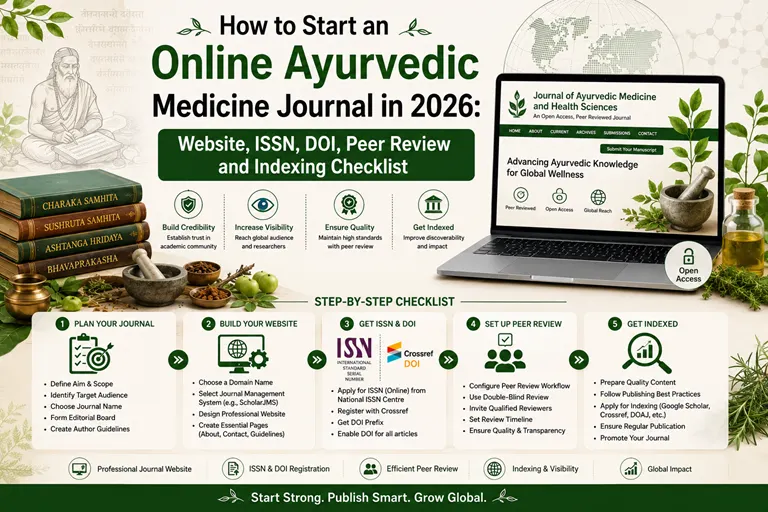
However, starting a scholarly journal today requires much more than publishing articles online.
A successful journal needs:
- A professional website
- A manuscript submission system
- Editorial and peer review workflows
- ISSN registration
- DOI infrastructure
- Publication ethics policies
- Indexing readiness
- Long-term publishing sustainability
This comprehensive guide provides a practical roadmap for launching an online Ayurvedic medicine journal in 2026.
Why Launch an Ayurvedic Medicine Journal?
Ayurvedic medicine has become increasingly interdisciplinary, encompassing areas such as:
- Clinical Ayurveda
- Integrative medicine
- Herbal drug research
- Pharmacognosy
- Public health
- Preventive medicine
- Traditional knowledge systems
- Pharmaceutical sciences
- Evidence-based healthcare
- Biomedical integration
International interest in Ayurveda and traditional medicine research has increased significantly, creating opportunities for new scholarly journals dedicated to scientific communication in these fields.
A well-managed journal can:
- Promote scientific evidence
- Encourage research collaboration
- Support early-career researchers
- Improve the visibility of Ayurveda research
- Contribute to global healthcare discussions
Step 1: Define the Journal's Mission and Scope
The first step is establishing a clear identity.
Ask the following questions:
- What subjects will the journal cover?
- Who is the target audience?
- What type of articles will be accepted?
- Will the journal focus on clinical research, review articles, case reports, or multidisciplinary studies?
A typical scope for an Ayurvedic medicine journal may include:
- Clinical research in Ayurveda
- Panchakarma studies
- Herbal and medicinal plant research
- Integrative medicine
- Pharmacological studies
- Public health and preventive medicine
- Traditional medicine education
- Translational research
- Evidence-based Ayurveda
A clearly defined scope helps attract the right authors and reviewers.
Step 2: Choose an Appropriate Journal Name
The journal title should:
- Reflect its academic discipline
- Be unique and memorable
- Avoid confusion with existing journals
- Be suitable for international audiences
The journal title becomes a permanent part of its identity and should therefore be selected carefully.
Step 3: Establish an Editorial Board
The credibility of a journal depends heavily on its editorial leadership.
A strong editorial board should include:
- Editor-in-Chief
- Associate Editors
- Subject Editors
- Editorial Advisory Board Members
- International experts where possible
Editors should possess relevant academic expertise and publication experience.
A transparent editorial structure improves trust among authors and readers.
Step 4: Develop a Professional Journal Website
The journal website serves as its digital headquarters.
A professional website should include:
- Home page
- About the Journal
- Aims and Scope
- Editorial Board
- Publication Ethics
- Author Guidelines
- Peer Review Policy
- Copyright Information
- Contact Information
- Current Issue
- Archives
- Submission System
The website should also be:
- Mobile responsive
- Secure
- Easy to navigate
- Search engine friendly
Modern journals increasingly require integrated publishing systems that combine websites with manuscript submission and editorial management capabilities.
Why a Manuscript Submission System is Essential
Managing manuscripts through email becomes difficult as submission volumes increase.
A professional manuscript management system provides:
- Online submission
- Editorial assignment
- Reviewer management
- Revision tracking
- Automated communication
- Publication workflows
Modern journal platforms such as ScholarJMS are designed to provide these capabilities while reducing technical complexity for editors and publishers.
Step 5: Develop Publication Policies
Every journal should establish clear policies regarding:
- Publication ethics
- Peer review
- Plagiarism
- Conflicts of interest
- Copyright
- Open access
- Retractions and corrections
Well-defined policies improve transparency and increase the credibility of the journal.
Step 6: Decide the Publication Frequency
The publication schedule should be realistic.
Common publication frequencies include:
- Quarterly
- Biannual
- Continuous publication
- Monthly
New journals often begin with two or four issues annually before expanding.
Step 7: Obtain an ISSN
An ISSN (International Standard Serial Number) is the official identifier of the journal.
An ISSN helps:
- Establish journal identity
- Improve discoverability
- Support indexing applications
- Facilitate library cataloguing
- Enhance credibility
Before applying for an ISSN, journals should ensure that:
- The website is complete.
- Editorial information is available.
- Publication policies are clearly displayed.
- The journal structure is fully developed.
Professional guidance can significantly simplify the ISSN application process.
Need Help Obtaining an ISSN?
OJSCloud provides support for:
- Journal website readiness
- ISSN consulting
- Publication policy preparation
- Journal launch guidance
- Editorial infrastructure development
WhatsApp: +91 82003 85143
Email: inquiry@ojscloud.com
Step 8: Plan DOI Registration from the Beginning
Many journals underestimate the importance of DOI planning.
DOIs provide:
- Permanent article identification
- Citation tracking
- Better discoverability
- Metadata distribution
- Long-term accessibility
Implementing DOI workflows early avoids complications later.
How Crossref DOI Supports Journal Growth
Crossref DOI registration helps journals:
- Improve article visibility
- Facilitate reference linking
- Strengthen metadata quality
- Support indexing readiness
- Enhance author confidence
Journals seeking guidance regarding DOI setup and implementation can obtain support through GetDOI.
Step 9: Build a Robust Peer Review System
Peer review remains the foundation of scholarly publishing.
A journal should define:
- Single-blind review
- Double-blind review
- Open peer review
- Reviewer selection criteria
- Decision timelines
Efficient peer review systems improve:
- Publication quality
- Author experience
- Journal reputation
Step 10: Create Author Guidelines
Author instructions should clearly explain:
- Manuscript preparation
- Article categories
- Formatting requirements
- Reference style
- Ethical requirements
- Submission procedures
Clear guidelines reduce submission errors and improve editorial efficiency.
Step 11: Prepare for Indexing
Many journal founders ask:
How can we get indexed quickly?
The answer is simple.
Build a high-quality journal first.
Indexing readiness depends upon:
- Publication consistency
- Ethical standards
- Editorial quality
- Metadata quality
- Website professionalism
- DOI implementation
- Peer review integrity
Indexing should be viewed as a long-term objective rather than an immediate outcome.
Common Indexing Pathways
Many journals gradually pursue inclusion in:
- Google Scholar
- ROAD
- OpenAlex
- Directory of Open Access Journals
- Subject-specific databases
Eligibility requirements vary among indexing services.
Step 12: Establish Publishing Workflows
A successful journal needs clear operational processes for:
- Submission management
- Reviewer assignment
- Editorial decisions
- Copyediting
- Production
- Publication scheduling
- Metadata management
Modern publishing systems significantly simplify these activities.
Why New Journals Need Integrated Publishing Platforms
Launching a journal requires coordination of multiple components:
- Website development
- Editorial workflows
- Peer review
- DOI implementation
- Metadata management
- Long-term maintenance
Integrated platforms such as ScholarJMS allow journals to manage these functions within a single environment.
Need Help Launching Your Journal?
We can help with:
- Journal website development
- ScholarJMS implementation
- OJS migration
- ISSN consulting
- Crossref DOI support
- Editorial workflow setup
- Journal launch consulting
WhatsApp: +91 82003 85143
Email: inquiry@ojscloud.com
Step 13: Plan for Long-Term Sustainability
Successful journals focus on sustainability from the beginning.
Areas requiring long-term planning include:
- Editorial succession
- Reviewer development
- Technical maintenance
- Funding models
- Publication quality
- Digital preservation
- Research integrity
A sustainable strategy ensures the journal can continue serving the scholarly community for years to come.
The Role of Transparent Publishing and Research Trust
Modern scholarly communication increasingly values:
- Transparency
- Publication ethics
- Reviewer accountability
- Research integrity
Platforms such as Scholar9 support initiatives related to transparent peer review and research trust ecosystems.
As Ayurvedic medicine research becomes more internationally visible, transparent editorial practices will continue to grow in importance.
Common Mistakes Made by New Journal Founders
Many new journals encounter avoidable challenges.
Common mistakes include:
- Launching without clear policies
- Delaying DOI planning
- Applying for ISSN prematurely
- Using manual editorial processes
- Lacking publication ethics statements
- Ignoring metadata quality
- Publishing inconsistently
Avoiding these issues significantly improves the chances of long-term success.
Frequently Asked Questions
How much does it cost to start an online journal?
Costs vary depending on website development, editorial infrastructure, DOI services, and operational requirements.
Can a journal obtain an ISSN before publishing articles?
Yes. Many journals obtain ISSNs before publishing their first issue, provided the website and journal information meet the necessary requirements.
Should every article receive a DOI?
Yes. DOI assignment is considered a best practice in scholarly publishing.
Is indexing possible immediately after launch?
Most indexing services require evidence of consistent publication quality and editorial standards.
Can small institutions successfully launch journals?
Yes. Many successful journals have been established by colleges, societies, and independent publishers with proper planning and infrastructure.
Conclusion
Launching an online Ayurvedic medicine journal in 2026 presents an exciting opportunity to contribute to the advancement of evidence-based traditional medicine and global scholarly communication.
However, long-term success requires much more than publishing articles online.
A successful journal should have:
- A professional website
- Efficient editorial workflows
- A manuscript submission system
- ISSN registration
- Crossref DOI planning
- Transparent peer review
- Indexing readiness
- Sustainable publishing practices
By establishing these foundations early, journal founders can create credible and impactful publication platforms that support the continued growth and international recognition of Ayurvedic medicine research.
If you are planning to launch a new journal or upgrade an existing publication, professional guidance can significantly simplify the process and help avoid many common challenges.