


How to Write a High-Quality Ayurvedic Case Report for Journal Publication
How to Write a High-Quality Ayurvedic Case Report for Journal Publication
Case reports have historically played an important role in the advancement of medical knowledge. Many important observations in medicine and healthcare have first been reported through carefully documented individual cases. In Ayurveda, where personalized treatment approaches and individualized patient assessment are fundamental principles, case reports remain one of the most valuable forms of scientific communication.
Ayurvedic practitioners frequently encounter unique clinical situations, rare presentations, successful management of chronic disorders, and innovative integrative treatment approaches. Unfortunately, many of these valuable experiences remain confined to clinical practice and never reach the wider scientific community.
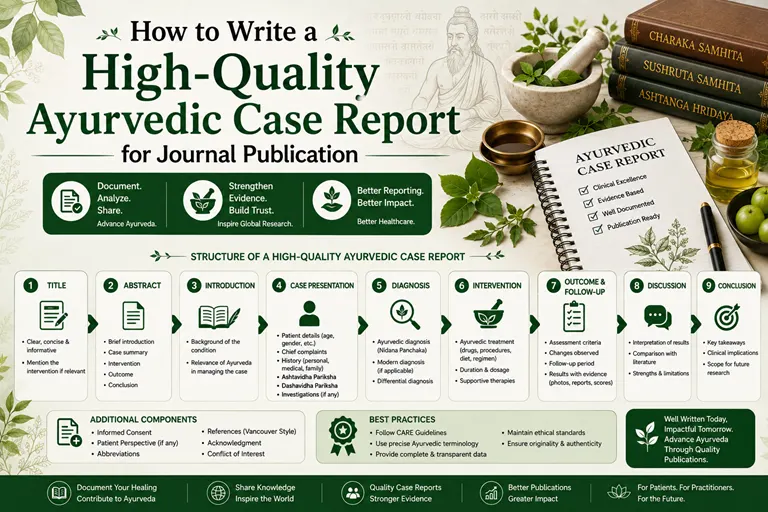
Publishing well-written case reports allows practitioners and researchers to share clinical experiences, generate research hypotheses, and contribute to the growing evidence base of Ayurveda.
This article provides a practical guide to writing high-quality Ayurvedic case reports suitable for publication in scholarly journals.
Why Are Case Reports Important in Ayurvedic Medicine?
Ayurveda places significant emphasis on individualized diagnosis and treatment. Clinical observations made in daily practice often provide valuable insights into:
- Disease understanding
- Personalized therapeutic approaches
- Novel treatment strategies
- Long-term patient management
- Integrative healthcare applications
- Safety and effectiveness observations
Case reports can contribute to:
- Evidence generation
- Clinical education
- Future research development
- Documentation of traditional practices
- Preservation of clinical knowledge
As evidence-based Ayurveda continues to gain international attention, high-quality case documentation has become increasingly important.
What Is an Ayurvedic Case Report?
An Ayurvedic case report is a detailed description of an individual patient's clinical condition, assessment, treatment, and outcomes using Ayurvedic principles and interventions.
A case report may involve:
- Rare diseases
- Unusual presentations
- Successful treatment outcomes
- Integrative therapeutic approaches
- Novel clinical observations
- Unexpected adverse events
- Long-term follow-up cases
The objective is not to prove effectiveness but to communicate important clinical experiences that may contribute to future research and clinical practice.
Characteristics of a High-Quality Ayurvedic Case Report
A publishable case report should be:
- Scientifically accurate
- Well-organized
- Clinically relevant
- Ethically sound
- Transparent
- Evidence-oriented
- Clearly written
The report should provide sufficient information for readers to understand the case and evaluate its significance.
Choosing the Right Case for Publication
Not every patient encounter requires publication.
Cases that are often suitable for publication include:
Rare Clinical Conditions
Cases involving uncommon diseases or presentations.
Unique Ayurvedic Management Approaches
Cases demonstrating innovative application of Ayurvedic principles.
Significant Clinical Improvement
Cases with noteworthy outcomes after treatment.
Integrative Healthcare Cases
Cases combining Ayurveda with modern medical approaches.
Long-Term Follow-Up Cases
Cases with substantial follow-up data and sustained outcomes.
Adverse Events or Safety Observations
Cases contributing to clinical safety and pharmacovigilance.
Essential Components of an Ayurvedic Case Report
Title
The title should be:
- Concise
- Informative
- Specific
- Search engine friendly
Example:
Ayurvedic Management of Chronic Psoriasis with Panchakarma and Herbal Formulations: A Case Report
Abstract
The abstract should briefly summarize:
- Background
- Patient information
- Intervention
- Outcome
- Significance
A structured abstract often improves readability.
Keywords
Include three to six keywords related to:
- Disease condition
- Ayurvedic intervention
- Research area
Appropriate keywords improve discoverability.
Introduction
The introduction should explain:
- The clinical importance of the condition
- Existing evidence
- Why the case is noteworthy
The section should provide context without becoming an extensive literature review.
Patient Information
Include:
- Age
- Gender
- Occupation
- Relevant medical history
- Presenting complaints
- Duration of illness
- Previous treatments
Personal identifiers should never be disclosed.
Clinical Findings
Describe:
- Physical examination
- Ayurvedic assessment
- Diagnostic findings
- Laboratory investigations
- Relevant observations
Ayurvedic Diagnosis
This section is particularly important.
Include:
- Dosha involvement
- Dushya
- Srotas
- Samprapti
- Nidana
- Ayurvedic diagnosis
A clear explanation of Ayurvedic reasoning strengthens the scientific value of the report.
Timeline
A chronological timeline improves clarity.
The timeline may include:
- Symptom onset
- Diagnosis
- Treatment initiation
- Follow-up visits
- Outcome assessment
Therapeutic Intervention
Provide detailed information regarding:
- Medicines prescribed
- Dosages
- Duration
- Panchakarma procedures
- Dietary advice
- Lifestyle modifications
The information should be sufficiently detailed to allow understanding of the intervention.
Follow-Up and Outcomes
Describe:
- Clinical changes
- Symptom improvement
- Laboratory findings
- Follow-up duration
- Patient-reported outcomes
Objective measurements strengthen the report.
Discussion
The discussion should explain:
- Why the treatment may have been effective
- Relationship to previous studies
- Clinical implications
- Strengths and limitations
Avoid making exaggerated claims.
Conclusion
The conclusion should summarize:
- Key clinical observations
- Potential implications
- Need for future research
Ethical Considerations in Case Report Publication
Ethical principles are extremely important.
Authors should obtain:
- Informed patient consent
- Permission to publish images
- Institutional approval where necessary
Patient confidentiality must always be maintained.
Failure to address ethical considerations can lead to manuscript rejection.
Importance of Clinical Documentation in Ayurveda
Many valuable clinical experiences are never published because documentation was incomplete.
Practitioners should routinely maintain:
- Clinical records
- Laboratory reports
- Photographs where appropriate
- Follow-up data
- Treatment details
Systematic documentation significantly improves publication quality.
Common Mistakes in Ayurvedic Case Reports
Many case reports are rejected because of avoidable errors.
Insufficient Clinical Information
Missing patient details reduce scientific value.
Lack of Ayurvedic Reasoning
Failure to explain the Ayurvedic diagnostic approach weakens the manuscript.
Inadequate Follow-Up
Short follow-up periods limit interpretation.
Overstated Conclusions
Case reports cannot establish definitive efficacy.
Poor Writing Quality
Unclear presentation reduces readability.
Missing Ethical Information
Failure to obtain patient consent is a serious concern.
How to Improve the Chances of Publication
To improve publication success:
- Select clinically meaningful cases.
- Follow journal guidelines carefully.
- Maintain scientific accuracy.
- Include objective evidence where possible.
- Write clearly and concisely.
- Ensure ethical compliance.
Peer review often focuses heavily on transparency and documentation quality.
Why Evidence-Based Case Reports Matter for Ayurveda
Evidence-based medicine increasingly values well-documented clinical observations.
Although case reports represent a lower level of evidence compared with randomized clinical trials, they remain extremely valuable for:
- Hypothesis generation
- Educational purposes
- Clinical innovation
- Rare disease reporting
- Integrative medicine research
High-quality case reports contribute to building a stronger evidence base for Ayurvedic medicine.
The Role of Journals in Promoting Clinical Documentation
Academic journals play an important role in encouraging practitioners to publish meaningful clinical experiences.
Publishing high-quality case reports can:
- Preserve traditional knowledge
- Encourage scientific discussion
- Promote evidence generation
- Improve patient care
- Support future research initiatives
The continued growth of Ayurvedic research depends partly on systematic clinical documentation and dissemination.
Preparing Your Manuscript for Submission
Before submission, authors should ensure that the manuscript includes:
- Title page
- Abstract
- Keywords
- Introduction
- Case presentation
- Discussion
- Conclusion
- References
- Patient consent statement
- Figures and tables where necessary
Following author guidelines carefully can significantly improve the likelihood of successful publication.
Need a Professional Journal Platform for Clinical Research Publishing?
As Ayurvedic research continues to grow, journals require efficient systems for managing manuscript submissions, peer review, and publication workflows.
Modern journal platforms such as ScholarJMS support:
- Manuscript submission
- Editorial management
- Peer review workflows
- Article publication
- Journal website management
Institutions and journal publishers seeking support for launching or upgrading scholarly journals can also obtain assistance through OJSCloud for:
- Journal website setup
- ISSN consulting
- OJS migration
- Editorial workflow development
- Publishing consultation
WhatsApp: +91 82003 85143
Email: inquiry@ojscloud.com
Frequently Asked Questions
What makes an Ayurvedic case report publishable?
A publishable case report should be clinically relevant, ethically sound, well-documented, and scientifically written.
Can a single patient case be published?
Yes. Many important medical observations are communicated through single-patient case reports.
Is patient consent necessary?
Yes. Informed patient consent is essential before publication.
Are photographs allowed in case reports?
Yes, provided patient privacy is protected and appropriate consent has been obtained.
Can case reports establish treatment efficacy?
No. Case reports generate hypotheses and provide clinical observations but cannot prove efficacy.
Conclusion
Case reports remain one of the most valuable forms of scientific communication in Ayurvedic medicine. They help preserve clinical experiences, promote evidence generation, and encourage scholarly discussion regarding traditional and integrative healthcare practices.
A high-quality Ayurvedic case report should be:
- Clinically meaningful
- Scientifically accurate
- Ethically compliant
- Well-documented
- Clearly written
As evidence-based Ayurveda continues to expand globally, practitioners and researchers have an important opportunity to contribute to the scientific literature through systematic clinical documentation and publication.
Well-prepared case reports not only enhance individual academic profiles but also strengthen the overall evidence base of Ayurvedic medicine and support its continued integration into global healthcare research.