


Integrative Ayurveda and Modern Healthcare: Research Opportunities for Scholars
Integrative Ayurveda and Modern Healthcare: Research Opportunities for Scholars
The global healthcare landscape is undergoing a significant transformation. Increasing attention is being given to preventive medicine, personalized healthcare, chronic disease management, and holistic approaches to well-being. In this evolving environment, Ayurveda has gained renewed interest among researchers, clinicians, policymakers, and patients worldwide.
Rather than viewing traditional and modern medicine as competing systems, many healthcare institutions are now exploring the possibilities of integrative healthcare, where evidence-based practices from multiple medical systems work together to improve patient outcomes.
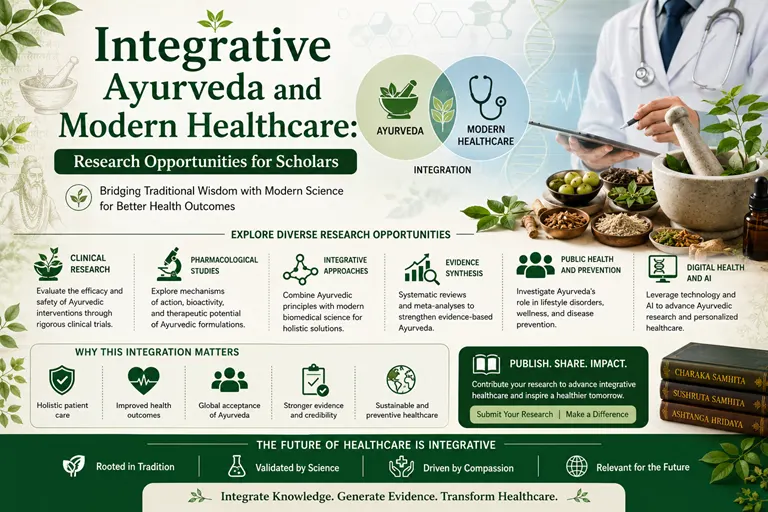
This changing paradigm presents exciting opportunities for scholars in Ayurvedic medicine, public health, pharmaceutical sciences, and biomedical research.
Integrative Ayurveda is no longer simply a philosophical concept. It is becoming an important area of scientific investigation with growing relevance to healthcare systems across the world.
Understanding Integrative Healthcare
Integrative healthcare refers to a patient-centered approach that combines conventional medicine with evidence-informed complementary and traditional healthcare practices.
Its primary objectives include:
- Improving patient outcomes
- Enhancing quality of life
- Promoting preventive healthcare
- Supporting personalized medicine
- Encouraging multidisciplinary care
The growing burden of chronic diseases, lifestyle disorders, and mental health conditions has accelerated interest in integrative approaches that address both physical and psychosocial aspects of health.
Why Ayurveda is Important in Integrative Medicine
Ayurveda offers several principles that align closely with contemporary healthcare priorities, including:
- Individualized treatment approaches
- Preventive healthcare strategies
- Lifestyle modification
- Dietary interventions
- Mind-body medicine
- Holistic patient assessment
Concepts such as Prakriti, Dinacharya, Ritucharya, and personalized therapeutic interventions increasingly attract scientific attention because of their potential applications in precision and preventive medicine.
Global Growth of Integrative Medicine Research
International healthcare organizations and research institutions have shown increasing interest in traditional medicine and integrative healthcare approaches. Research involving herbal medicine, complementary therapies, and patient-centered care models continues to expand globally.
This growth has created numerous opportunities for interdisciplinary research involving Ayurveda and modern medicine.
Emerging Research Areas in Integrative Ayurveda
Chronic Disease Management
Chronic diseases represent one of the most significant healthcare challenges worldwide.
Research opportunities include:
- Diabetes management
- Obesity and metabolic disorders
- Hypertension
- Arthritis
- Cardiovascular diseases
- Autoimmune disorders
Investigating how Ayurvedic interventions can complement conventional treatment strategies is an increasingly important research area.
Integrative Oncology
Cancer care has witnessed growing interest in supportive and integrative interventions.
Potential research areas include:
- Quality of life improvement
- Management of treatment-related side effects
- Nutritional interventions
- Mental well-being
- Palliative care support
Well-designed clinical studies can provide valuable evidence regarding the role of Ayurveda in comprehensive cancer care.
Mental Health and Wellness
Modern healthcare increasingly recognizes the importance of mental health and emotional well-being.
Research opportunities include:
- Stress management
- Anxiety disorders
- Sleep disturbances
- Depression
- Mind-body interventions
- Meditation and yoga integration
The holistic framework of Ayurveda offers numerous possibilities for interdisciplinary mental health research.
Women's Health Research
Women's health represents another important area of investigation.
Potential topics include:
- Menstrual disorders
- Menopausal health
- Reproductive wellness
- Polycystic ovarian syndrome
- Maternal healthcare
- Preventive interventions
Integrative approaches may provide valuable insights into personalized healthcare strategies.
Healthy Ageing and Geriatric Care
Ageing populations present significant healthcare challenges worldwide.
Research opportunities include:
- Healthy ageing strategies
- Cognitive health
- Functional independence
- Quality of life improvement
- Preventive interventions
- Long-term wellness programs
Ayurveda's emphasis on preventive healthcare and rejuvenation therapies makes this an important area for future research.
Public Health and Preventive Medicine
Preventive healthcare has become a major priority globally.
Research areas include:
- Lifestyle interventions
- Community health programs
- Nutrition and wellness
- Non-communicable disease prevention
- Health promotion strategies
- School and workplace wellness initiatives
Integrating Ayurvedic principles into public health research can generate valuable evidence for healthcare policy and preventive medicine.
Personalized and Precision Medicine
Modern medicine increasingly recognizes the importance of individualized healthcare.
Interestingly, Ayurveda has long emphasized personalized treatment approaches based on:
- Prakriti assessment
- Dosha predominance
- Individual constitution
- Lifestyle patterns
This convergence between traditional concepts and precision medicine creates exciting opportunities for interdisciplinary research.
Medicinal Plant and Herbal Drug Research
Research in medicinal plants remains one of the most active areas of Ayurvedic science.
Important topics include:
- Phytochemistry
- Pharmacognosy
- Standardization
- Quality control
- Safety evaluation
- Pharmacological mechanisms
Collaborative research between Ayurvedic scholars and pharmaceutical scientists can significantly strengthen evidence generation.
Integrative Research Methodologies
The future of integrative Ayurveda depends largely on the quality of research methodologies.
Scholars should consider:
- Clinical trials
- Observational studies
- Case reports
- Cohort studies
- Systematic reviews
- Meta-analyses
- Qualitative research
- Mixed-method research designs
Methodological rigor is essential for producing evidence that is both scientifically robust and clinically meaningful.
Challenges in Integrative Ayurveda Research
Despite significant opportunities, several challenges remain.
Methodological Difficulties
Traditional medical systems often require research designs that accommodate individualized interventions.
Standardization Issues
Variations in formulations and treatment approaches may complicate study design.
Funding Constraints
Integrative research projects sometimes face limited funding opportunities.
Interdisciplinary Communication
Researchers from different disciplines may have differing perspectives and methodologies.
Addressing these challenges requires collaboration, innovation, and methodological flexibility.
Importance of Clinical Documentation
Clinical documentation forms the foundation of evidence generation.
Researchers and practitioners should maintain:
- Detailed patient records
- Follow-up information
- Outcome measurements
- Adverse event documentation
- Intervention details
High-quality documentation contributes significantly to future research and publication opportunities.
Publication Opportunities for Scholars
The growing field of integrative healthcare has created numerous opportunities for publication.
Potential article types include:
- Original research articles
- Clinical studies
- Systematic reviews
- Case reports
- Short communications
- Public health studies
- Educational research
- Methodological papers
Scholars who produce rigorous, evidence-based work can contribute significantly to the advancement of integrative medicine.
Why Academic Journals Play an Important Role
Scholarly journals provide platforms for:
- Scientific communication
- Evidence dissemination
- Interdisciplinary collaboration
- Research visibility
- Academic discussion
Journals dedicated to Ayurvedic medicine and integrative healthcare play a vital role in strengthening the evidence base and encouraging scholarly engagement.
Future Directions in Integrative Ayurveda Research
Several emerging areas may shape the future of research:
- Digital health applications
- Artificial intelligence in traditional medicine research
- Precision healthcare
- Systems biology approaches
- Biomarker research
- Health economics
- Implementation science
- Patient-centered outcomes research
These interdisciplinary fields offer substantial opportunities for young researchers and established scholars alike.
Building International Collaboration
Collaborative research can significantly improve the quality and impact of scientific studies.
Potential collaborators include:
- Medical colleges
- Ayurveda institutions
- Public health researchers
- Pharmaceutical scientists
- Biostatisticians
- Healthcare policymakers
International collaboration also improves visibility and facilitates high-quality research output.
A Growing Need for Efficient Scholarly Publishing
As research activity in integrative Ayurveda increases, journals require modern systems capable of handling:
- Manuscript submission
- Peer review
- Editorial management
- Publication workflows
- Metadata management
- DOI integration
Modern journal platforms such as ScholarJMS support these requirements by providing integrated solutions for scholarly publishing.
Institutions and journal publishers seeking support for launching or upgrading journals can also obtain assistance through OJSCloud for:
- Journal website development
- ISSN consulting
- OJS migration
- Editorial workflow setup
- Publishing consultation
Journals requiring support for Crossref DOI implementation and metadata workflows can obtain guidance through GetDOI.
WhatsApp: +91 82003 85143
Email: inquiry@ojscloud.com
Frequently Asked Questions
What is integrative Ayurveda?
Integrative Ayurveda refers to the combination of evidence-based Ayurvedic principles and conventional healthcare approaches to improve patient outcomes and support holistic care.
Is there growing demand for integrative medicine research?
Yes. Interest in complementary and traditional medicine research has expanded considerably worldwide.
What are the major research opportunities in integrative Ayurveda?
Key areas include chronic disease management, mental health, public health, oncology, women's health, medicinal plant research, and precision medicine.
Can Ayurvedic scholars collaborate with modern medical researchers?
Yes. Interdisciplinary collaboration is increasingly encouraged and can strengthen research quality and impact.
What type of articles can scholars publish in this field?
Researchers can publish original studies, reviews, case reports, public health research, and interdisciplinary investigations.
Conclusion
Integrative Ayurveda and modern healthcare represent one of the most promising frontiers in contemporary medical research.
The growing emphasis on preventive medicine, personalized care, holistic health, and evidence-based traditional medicine has created unprecedented opportunities for scholars across multiple disciplines.
By embracing interdisciplinary collaboration, rigorous methodologies, and high-quality clinical documentation, researchers can contribute significantly to the scientific understanding and global recognition of Ayurveda.
As healthcare systems continue to evolve, integrative approaches that combine the strengths of traditional knowledge and modern science may play an increasingly important role in improving patient care and promoting sustainable healthcare solutions.
For scholars, this is an exciting time to engage in meaningful research that not only advances scientific knowledge but also contributes to the future of global health.