


OJS vs ScholarJMS: Which Platform Is Better for New Ayurvedic Medicine Journals?
OJS vs ScholarJMS: Which Platform Is Better for New Ayurvedic Medicine Journals?
The growth of evidence-based Ayurveda, integrative medicine, herbal therapeutics, and traditional medicine research has created significant opportunities for launching new scholarly journals in Ayurvedic medicine. Universities, Ayurveda colleges, research institutes, and professional societies are increasingly establishing online journals to disseminate research findings and improve global visibility.
However, one of the most important decisions for a new journal is selecting the right journal management platform.
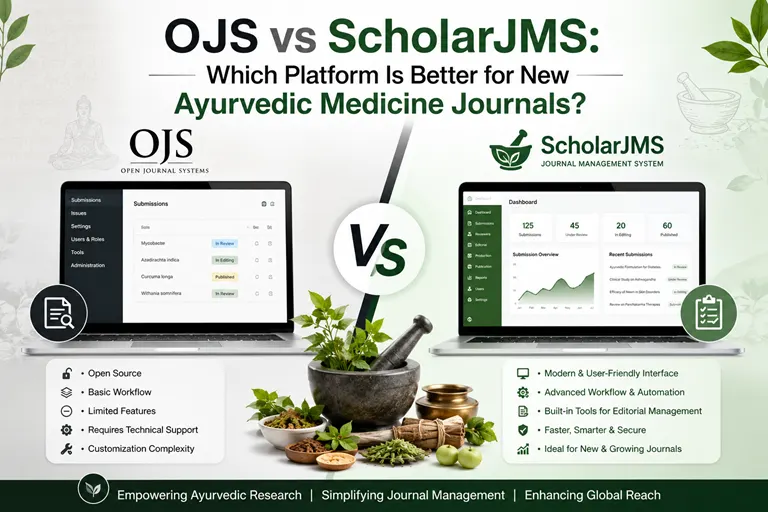
For many years, the Open Journal Systems platform, commonly known as OJS, has been a popular option for academic publishers. At the same time, modern journal management platforms such as ScholarJMS have emerged to address the growing needs of editors, publishers, and authors who require streamlined workflows and better user experiences.
For founders of new Ayurvedic medicine journals, the question often becomes:
Should we use OJS or ScholarJMS?
This article compares both platforms from the perspective of Ayurvedic journal publishers and editorial teams.
Why Platform Selection Matters for Ayurvedic Medicine Journals
Ayurvedic medicine journals often handle diverse manuscript types, including:
- Original research articles
- Clinical studies
- Case reports
- Review articles
- Pharmacognosy and phytochemistry studies
- Integrative medicine research
- Public health and traditional medicine studies
Managing these submissions requires more than a simple website. Journals need:
- Manuscript submission systems
- Editorial workflow management
- Peer review tools
- DOI integration
- Publication management
- Author communication tools
- Long-term scalability
Selecting the wrong platform can create operational challenges that affect authors, reviewers, and editors.
Understanding Open Journal Systems (OJS)
Open Journal Systems is an open-source journal publishing software developed to support scholarly publishing.
OJS offers:
- Online manuscript submission
- Peer review workflow
- Editorial management
- Publishing and archiving features
- Multi-journal support
- Plugin ecosystem
Because OJS is open source, it is widely adopted by universities and academic institutions worldwide.
Strengths of OJS for Ayurvedic Journals
Low Initial Software Cost
Since OJS is open source, there are no licensing fees.
Large Global Community
Thousands of journals use OJS, which means documentation and community support are widely available.
Flexible Customization
Institutions with technical expertise can customize the platform according to their requirements.
Plugin Availability
Various plugins exist for indexing, DOI registration, statistics, and metadata management.
Challenges of OJS for New Ayurvedic Journals
Despite its strengths, OJS also presents several challenges for newly established journals.
Technical Complexity
Installing and configuring OJS often requires:
- Server management
- Security configuration
- Database administration
- Plugin maintenance
- Regular updates
Many Ayurveda colleges and societies launching journals may not have dedicated technical teams.
Steep Learning Curve
Editors and authors frequently need training to understand:
- Editorial workflows
- Submission settings
- Review assignments
- Publishing configuration
Ongoing Maintenance Requirements
OJS installations require:
- Security patches
- Version upgrades
- Plugin compatibility checks
- Server monitoring
Without proper maintenance, journals may experience performance issues.
Design Limitations
Many new journals seek modern, professional websites that inspire confidence among authors and readers. Achieving this often requires additional customization and development work.
What is ScholarJMS?
ScholarJMS is a modern journal website and manuscript management platform specifically designed to simplify scholarly publishing workflows.
The platform combines:
- Journal website development
- Manuscript submission
- Editorial workflow management
- Peer review management
- Publishing workflow
- Author communication
- Production management
The objective is to allow editors to focus on publishing quality research rather than managing technical systems.
Why ScholarJMS is Becoming Popular Among New Journals
New and emerging journals often prefer platforms that are easier to launch and manage.
ScholarJMS offers:
- User-friendly interfaces
- Simplified workflows
- Faster journal setup
- Reduced technical burden
- Professional journal websites
- Integrated publishing tools
For many Ayurvedic medicine journals, these features can significantly reduce administrative complexity.
OJS vs ScholarJMS: Feature Comparison
| Feature | OJS | ScholarJMS |
|---|---|---|
| Installation Complexity | High | Low |
| Technical Expertise Required | Significant | Minimal |
| Modern User Interface | Moderate | High |
| Editorial Workflow Simplicity | Moderate | High |
| Journal Website Design | Custom Development Needed | Built In |
| Technical Maintenance | Required | Managed |
| New Journal Setup Speed | Moderate | Fast |
| Author Experience | Variable | User Friendly |
| Support for Journal Launch | Limited | Comprehensive |
| Publishing Consultation | External | Available |
Which Platform is Better for New Ayurvedic Medicine Journals?
The answer depends on the journal's objectives and available resources.
OJS May Be Suitable If:
- Your institution has an experienced IT department.
- You have dedicated server administrators.
- You require extensive custom development.
- You are comfortable managing upgrades and maintenance.
ScholarJMS May Be Suitable If:
- You want to launch quickly.
- You prefer managed workflows.
- You need a professional journal website.
- You do not have technical staff.
- You want integrated publishing support.
For many emerging Ayurvedic medicine journals, ease of management often becomes a major deciding factor.
Special Requirements of Ayurvedic Medicine Journals
Ayurveda journals frequently aim to improve:
- International visibility
- Research quality
- Citation performance
- Indexing readiness
- Author experience
- Editorial efficiency
These objectives require robust digital publishing infrastructure.
An effective manuscript management platform can contribute significantly to achieving these goals.
Why DOI Planning Matters from the Beginning
Many new journals delay DOI planning until after publication, which often creates unnecessary complications.
Crossref DOI integration should ideally be considered during the journal setup stage because it supports:
- Persistent article identification
- Citation tracking
- Metadata dissemination
- Long-term discoverability
Journals seeking assistance with Crossref DOI registration, sponsorship, and workflow implementation can obtain support through GetDOI, which provides guidance for DOI setup and publishing workflows.
The Importance of ISSN and Journal Readiness
Launching a scholarly journal requires more than publishing articles online.
Journals should also ensure:
- Website readiness
- Publication policies
- Editorial structure
- Ethical guidelines
- Metadata standards
- ISSN preparation
Many new publishers seek professional support to ensure their journal meets these requirements before applying for an ISSN.
Need Help Launching or Upgrading Your Journal?
We can help with:
- ScholarJMS journal website setup
- OJS migration
- ISSN consulting
- Crossref DOI support
- Journal workflow setup
- Editorial process consulting
WhatsApp: +91 82003 85143
Email: inquiry@ojscloud.com
OJS Migration: When Should Journals Consider Moving?
Some journals initially adopt OJS and later decide to migrate because of:
- Technical maintenance challenges
- User experience concerns
- Workflow inefficiencies
- Limited in-house technical support
Migration may be beneficial when:
- Editorial teams are spending excessive time managing software.
- Authors encounter submission difficulties.
- The website requires modernization.
- The journal plans to expand.
Professional migration support can help journals move content, metadata, and workflows smoothly.
Why Editorial Workflow Matters in Ayurvedic Publishing
Ayurvedic medicine research is becoming increasingly multidisciplinary.
Journals often publish work related to:
- Clinical medicine
- Pharmacology
- Ethnobotany
- Public health
- Integrative medicine
- Pharmaceutical sciences
Managing these diverse submissions efficiently requires a platform that can support editors and reviewers throughout the publication process.
A streamlined workflow helps:
- Reduce publication delays
- Improve author satisfaction
- Enhance editorial efficiency
- Strengthen journal reputation
How Scholar9 Supports Research Trust and Transparency
Modern scholarly publishing increasingly values transparency and trust.
Platforms such as Scholar9 contribute to this ecosystem by supporting:
- Transparent peer review practices
- Research integrity initiatives
- Scholarly trust mechanisms
- Improved research visibility
As Ayurvedic medicine research continues to expand internationally, transparency and publication ethics will become increasingly important for journal success.
Need Guidance for Starting an Ayurvedic Medicine Journal?
Whether you are planning to launch a new journal or upgrade an existing one, professional guidance can significantly reduce the complexity of the process.
Support is available for:
- New journal website development
- OJS to ScholarJMS migration
- ISSN consulting
- Crossref DOI support
- Editorial workflow setup
- Journal launch consulting
WhatsApp: +91 82003 85143
Email: inquiry@ojscloud.com
Frequently Asked Questions
Is OJS free?
Yes. OJS is open-source software and can be downloaded without licensing fees. However, hosting, customization, maintenance, and technical support may involve additional costs.
Is ScholarJMS suitable for new Ayurvedic journals?
Yes. ScholarJMS is particularly suitable for emerging journals that require a professional website and simplified editorial workflow without extensive technical management.
Can an OJS journal migrate to ScholarJMS?
Yes. Existing journals can migrate their content, workflows, and metadata with professional assistance.
Do Ayurvedic journals need Crossref DOI registration?
DOIs are highly recommended because they improve article discoverability, citation tracking, and long-term accessibility.
Can new journals obtain ISSN support?
Yes. Professional consulting services can assist journals in preparing for ISSN applications and ensuring website readiness.
Conclusion
The choice between OJS and ScholarJMS ultimately depends on a journal's technical capacity, publishing goals, and long-term vision.
OJS remains an excellent platform for institutions with strong technical resources and the ability to manage software infrastructure internally.
However, many newly established Ayurvedic medicine journals seek a solution that combines professional website development, simplified workflows, publishing consultation, and reduced technical complexity. For these journals, ScholarJMS offers a compelling alternative.
As Ayurvedic research continues to gain international recognition, journals need efficient digital publishing systems that allow editors to focus on scientific quality rather than software administration.
Choosing the right platform today can significantly influence a journal's growth, reputation, and publishing success in the years ahead.