


Phytochemical, Pharmacological, and Clinical Research Trends in Ayurvedic Medicine
Phytochemical, Pharmacological, and Clinical Research Trends in Ayurvedic Medicine
Ayurveda has served as a cornerstone of traditional healthcare for thousands of years, offering holistic approaches to disease prevention, treatment, and wellness. Today, the scientific community is increasingly focusing on understanding the molecular mechanisms, bioactive compounds, and clinical effectiveness of Ayurvedic medicines through modern research methodologies.
The growing demand for evidence-based traditional medicine has created exciting opportunities in phytochemical analysis, pharmacological investigations, and clinical research. Advanced analytical technologies, systems biology, network pharmacology, and translational research are enabling scholars to bridge ancient Ayurvedic wisdom with contemporary biomedical science.
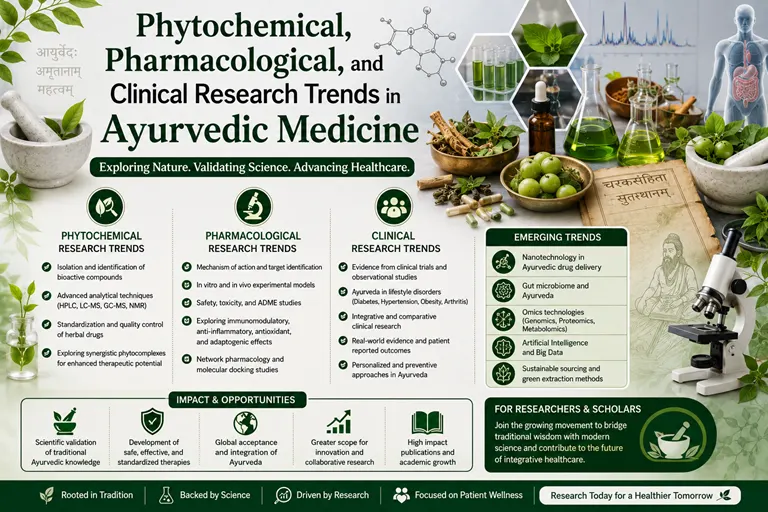
For researchers, postgraduate scholars, and academic institutions, this represents one of the most promising frontiers in modern healthcare research.
The Evolution of Scientific Research in Ayurveda
Historically, Ayurvedic formulations and medicinal plants were evaluated primarily through empirical observations and classical knowledge. Today, researchers increasingly employ:
- Advanced phytochemical analysis
- Molecular pharmacology
- Clinical trials
- Metabolomics
- Network pharmacology
- Bioinformatics
- Translational medicine approaches
These methodologies are helping scientists understand how traditional medicines exert their therapeutic effects and how they may contribute to modern healthcare solutions.
Why Phytochemical Research Matters in Ayurveda
Phytochemicals are naturally occurring bioactive compounds present in medicinal plants.
Many Ayurvedic herbs contain:
- Alkaloids
- Flavonoids
- Polyphenols
- Glycosides
- Terpenoids
- Tannins
- Saponins
- Phenolic compounds
These compounds often possess:
- Anti-inflammatory activity
- Antioxidant properties
- Immunomodulatory effects
- Antimicrobial activity
- Neuroprotective potential
- Antidiabetic effects
Modern analytical techniques are helping researchers identify these compounds and understand their mechanisms of action.
Emerging Trends in Phytochemical Research
Advanced Phytochemical Profiling
Modern techniques include:
- High-performance liquid chromatography (HPLC)
- Liquid chromatography-mass spectrometry (LC-MS)
- Gas chromatography-mass spectrometry (GC-MS)
- Nuclear magnetic resonance (NMR)
- Fourier-transform infrared spectroscopy (FTIR)
These technologies enable researchers to:
- Identify bioactive molecules
- Standardize formulations
- Detect biomarkers
- Improve quality control
Standardization of Herbal Formulations
One of the major challenges in herbal medicine is ensuring consistency.
Current research increasingly focuses on:
- Marker compounds
- Chemical fingerprinting
- Batch-to-batch consistency
- Quality assurance
- Standardized extracts
Standardization is becoming essential for improving global acceptance of Ayurvedic medicines.
Metabolomics and Systems Biology
Metabolomics allows researchers to study:
- Metabolic pathways
- Therapeutic responses
- Biomarker identification
- Mechanisms of action
This approach is helping scientists understand complex polyherbal formulations and their multi-target therapeutic effects.
Pharmacological Research Trends in Ayurveda
Pharmacological research attempts to answer a fundamental question:
How do Ayurvedic medicines work?
Modern pharmacological investigations are increasingly focusing on:
Anti-Inflammatory Activities
Many medicinal plants are being studied for their potential role in managing:
- Arthritis
- Autoimmune diseases
- Inflammatory disorders
- Chronic pain conditions
Antioxidant Properties
Oxidative stress plays a role in numerous chronic diseases.
Research is exploring the antioxidant potential of various Ayurvedic formulations in:
- Ageing
- Metabolic diseases
- Neurodegenerative disorders
- Cardiovascular diseases
Immunomodulatory Effects
Immunity has become a major area of healthcare research.
Studies are investigating how Ayurvedic formulations may influence:
- Immune regulation
- Host defense mechanisms
- Inflammatory pathways
- Disease prevention
Neuropharmacology
Network pharmacology and computational studies have identified numerous phytochemicals in Ayurvedic herbs that may interact with neurological pathways and therapeutic targets.
Research areas include:
- Cognitive disorders
- Neurodegenerative diseases
- Stress management
- Mental health conditions
- Sleep disorders
Antidiabetic and Metabolic Research
The increasing prevalence of diabetes and obesity has stimulated substantial interest in:
- Herbal antidiabetic compounds
- Metabolic regulation
- Insulin sensitivity
- Weight management interventions
Computational and laboratory studies continue to identify promising phytochemicals and molecular targets relevant to metabolic disorders.
Clinical Research Trends in Ayurvedic Medicine
The scientific community increasingly recognizes the importance of high-quality clinical evidence.
Observational Studies
Observational research helps generate:
- Real-world evidence
- Long-term outcome data
- Safety information
- Patient-reported outcomes
Clinical Trials
Clinical trials remain essential for:
- Evaluating effectiveness
- Assessing safety
- Comparing interventions
- Generating robust evidence
Recently, researchers at the Banaras Hindu University reported the world's first published Ayurvedic N-of-1 clinical trial, demonstrating growing methodological innovation within Ayurvedic research.
Integrative Medicine Studies
Increasingly, researchers are investigating how Ayurvedic interventions may complement conventional healthcare in:
- Chronic disease management
- Oncology
- Mental health
- Public health
- Preventive medicine
Case Reports and Case Series
Clinical documentation remains a valuable source of:
- Novel observations
- Rare case descriptions
- Hypothesis generation
- Educational evidence
Phytopharmaceutical Development: A New Frontier
India has introduced a distinct regulatory pathway for phytopharmaceuticals, creating opportunities to develop standardized plant-based medicines supported by modern scientific evidence.
Phytopharmaceutical research focuses on:
- Standardized plant extracts
- Safety evaluation
- Pharmacological mechanisms
- Clinical efficacy
- Regulatory compliance
This area is expected to become increasingly important for translating traditional knowledge into globally accepted therapeutic products.
Medicinal Plant Research Opportunities
Several areas remain underexplored and present excellent opportunities for researchers:
- Ethnopharmacology
- Bioactive compound isolation
- Novel drug discovery
- Molecular mechanisms
- Toxicological studies
- Formulation science
- Nanotechnology applications
- Bioavailability studies
India's rich biodiversity offers enormous potential for future discoveries in medicinal plant research.
Challenges in Phytochemical and Pharmacological Research
Despite remarkable progress, several challenges remain.
Standardization Difficulties
Natural products often exhibit variability due to:
- Geography
- Climate
- Cultivation practices
- Harvesting conditions
Complex Formulations
Polyherbal formulations contain numerous compounds with potential synergistic interactions, making mechanistic investigations challenging.
Clinical Validation
Large-scale, high-quality clinical studies remain limited for many formulations.
Regulatory Requirements
Developing globally accepted phytopharmaceuticals requires:
- Extensive safety data
- Standardization
- Quality control
- Clinical evidence
Addressing these challenges represents an important opportunity for future researchers.
Publication Opportunities for Scholars
The expanding field of Ayurvedic medicine offers numerous publication opportunities.
Researchers can publish:
- Original research articles
- Clinical studies
- Systematic reviews
- Pharmacological investigations
- Phytochemical analyses
- Translational research
- Case reports
- Methodological papers
- Public health studies
High-quality publications contribute significantly to strengthening the scientific evidence base of Ayurveda.
Future Directions in Ayurvedic Research
Several emerging technologies are likely to shape future research:
- Artificial intelligence
- Network pharmacology
- Multi-omics approaches
- Systems biology
- Precision medicine
- Computational drug discovery
- Pharmaco-metabolomics
- Digital health technologies
The convergence of traditional medicine and modern scientific methodologies is creating unprecedented opportunities for innovation and discovery.
The Role of Academic Journals in Advancing Research
Scholarly journals play an essential role in:
- Disseminating evidence
- Encouraging interdisciplinary collaboration
- Supporting scientific communication
- Improving research visibility
- Advancing evidence-based Ayurveda
Journals dedicated to Ayurvedic medicine and integrative healthcare provide valuable platforms for researchers working in these rapidly evolving fields.
A Growing Need for Modern Scholarly Publishing Infrastructure
As research activity in Ayurveda expands, journals increasingly require efficient systems for managing:
- Manuscript submission
- Peer review
- Editorial workflows
- Metadata management
- DOI integration
- Publication processes
Modern journal platforms such as ScholarJMS provide integrated solutions that support scholarly publishing and journal growth.
Institutions and journal publishers seeking support for launching or upgrading journals can also obtain assistance through OJSCloud for:
- Journal website development
- ISSN consulting
- OJS migration
- Editorial workflow setup
- Publishing consultation
Journals requiring assistance with Crossref DOI implementation and metadata workflows can obtain support through GetDOI.
WhatsApp: +91 82003 85143
Email: inquiry@ojscloud.com
Frequently Asked Questions
What is phytochemical research in Ayurveda?
Phytochemical research involves the identification and characterization of bioactive compounds present in medicinal plants and Ayurvedic formulations.
Why is pharmacological research important in Ayurveda?
Pharmacological research helps explain the mechanisms of action, safety, and therapeutic potential of Ayurvedic medicines.
What are phytopharmaceuticals?
Phytopharmaceuticals are standardized plant-based medicines developed using modern scientific and regulatory frameworks.
What are the emerging areas of Ayurvedic clinical research?
Emerging areas include chronic disease management, integrative medicine, personalized medicine, metabolomics, and computational pharmacology.
What publication opportunities exist for scholars?
Researchers can publish original research articles, reviews, clinical studies, pharmacological investigations, and translational research papers.
Conclusion
Phytochemical, pharmacological, and clinical research in Ayurvedic medicine is entering an exciting era of scientific advancement.
Modern analytical technologies, computational approaches, translational medicine, and innovative clinical research designs are helping researchers bridge ancient knowledge and contemporary biomedical science.
The future of evidence-based Ayurveda will depend heavily on:
- Rigorous scientific methodologies
- High-quality clinical evidence
- Standardization of herbal medicines
- Interdisciplinary collaboration
- Effective scholarly communication
For researchers and scholars, these developments present unprecedented opportunities to contribute to the scientific understanding of Ayurvedic medicine and its role in modern healthcare.
As global interest in traditional medicine continues to grow, high-quality research and publication will remain essential for strengthening the credibility, acceptance, and future development of Ayurveda.