


Why Ayurvedic Journals Need a Modern Manuscript Submission and Peer Review System
Why Ayurvedic Journals Need a Modern Manuscript Submission and Peer Review System
Ayurveda is one of the world's oldest and most respected systems of medicine. In recent years, scientific interest in traditional medicine, herbal therapeutics, integrative healthcare, and evidence-based Ayurveda has expanded significantly. Universities, research institutes, Ayurveda colleges, and professional associations are producing a growing volume of scholarly research that deserves professional dissemination through high-quality journals.
As the quantity and complexity of submissions increase, Ayurvedic medicine journals face a critical challenge.
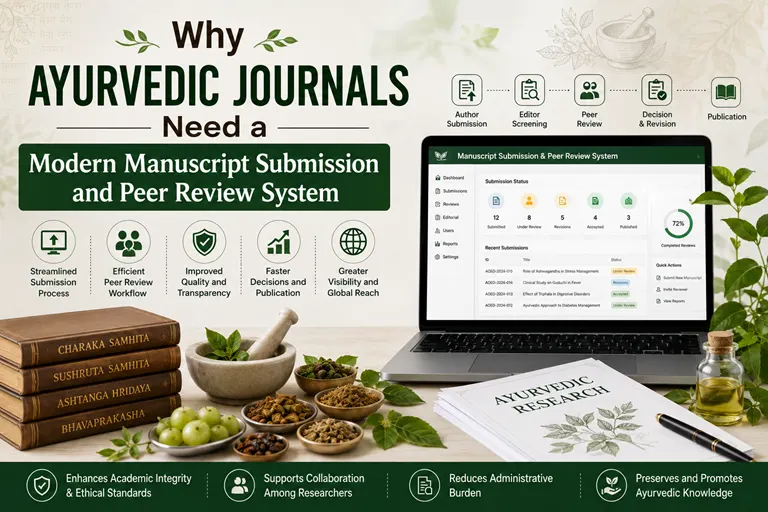
Can traditional editorial methods still meet the expectations of modern researchers?
For many journals, the answer is increasingly no.
Managing submissions through email, spreadsheets, and manual tracking systems often creates inefficiencies that affect authors, editors, and reviewers alike. Modern scholarly publishing demands digital solutions that can streamline editorial operations while maintaining scientific rigor and publication ethics.
A modern manuscript submission and peer review system has therefore become an essential component of successful Ayurvedic journal publishing.
The Changing Landscape of Ayurvedic Research Publishing
The field of Ayurvedic medicine has evolved considerably during the last two decades.
Current research areas include:
- Evidence-based Ayurveda
- Clinical trials
- Integrative medicine
- Pharmacognosy and phytochemistry
- Medicinal plant research
- Public health and preventive medicine
- Panchakarma research
- Standardization of herbal formulations
- Pharmaceutical and pharmacological studies
- Traditional medicine education
Researchers increasingly expect journals to provide efficient and transparent publishing experiences similar to those offered by international medical and scientific journals.
This expectation extends beyond article quality and includes:
- Simple online submission
- Transparent peer review
- Efficient communication
- Faster editorial decisions
- Professional publication processes
Challenges Faced by Traditional Editorial Workflows
Many emerging journals still rely on manual processes.
Submissions may arrive through:
- Email attachments
- Shared folders
- Spreadsheet tracking
- Multiple communication channels
Although such methods may work initially, they often become difficult to manage as the journal grows.
Common Problems of Manual Editorial Systems
Lost or Misplaced Manuscripts
Tracking manuscripts through email chains can become confusing, especially when multiple revisions are involved.
Delayed Editorial Decisions
Manual assignment of reviewers often results in unnecessary delays.
Inconsistent Communication
Authors may receive irregular updates regarding the status of their manuscripts.
Difficulty Managing Reviewer Information
Maintaining reviewer databases manually becomes increasingly challenging as submission volume increases.
Limited Transparency
Editors may struggle to monitor:
- Review timelines
- Revision history
- Pending decisions
- Reviewer performance
These issues can negatively affect both journal reputation and author satisfaction.
Why Authors Expect Digital Submission Systems
Researchers today are accustomed to digital publishing platforms.
When submitting a manuscript, authors expect the ability to:
- Submit online
- Upload supplementary files
- Track manuscript status
- Receive automated notifications
- Download decision letters
- View revision requests
A journal that lacks these capabilities may appear less professional, even if the scientific quality of its articles is excellent.
The Growing Importance of Peer Review Efficiency
Peer review remains the cornerstone of scholarly publishing.
For Ayurvedic medicine journals, rigorous peer review is particularly important because the field encompasses:
- Clinical interventions
- Traditional therapeutic methods
- Herbal medicine research
- Integrative healthcare studies
- Public health applications
A well-structured peer review process helps ensure:
- Scientific integrity
- Research credibility
- Ethical publishing standards
- Improved article quality
- International acceptance
However, peer review itself can become difficult to manage without digital infrastructure.
What is a Modern Manuscript Submission System?
A modern manuscript submission system is an integrated platform that manages the complete editorial workflow from submission to publication.
Typical features include:
- Author registration
- Online submission
- Editorial assignment
- Reviewer management
- Revision tracking
- Communication tools
- Decision management
- Production workflows
- Publication scheduling
- Archive management
The purpose of such systems is to reduce administrative burden and improve efficiency.
Key Benefits for Ayurvedic Medicine Journals
Improved Author Experience
A professional submission platform creates confidence among authors.
Researchers are more likely to submit to journals that offer:
- Simple submission procedures
- Transparent communication
- Timely editorial decisions
Faster Editorial Processing
Automation reduces many repetitive tasks, including:
- Acknowledgement emails
- Reviewer invitations
- Reminder notifications
- Status tracking
This allows editors to focus more on scientific quality and less on administration.
Better Reviewer Management
Modern systems maintain reviewer databases and help editors:
- Identify suitable reviewers
- Track response times
- Monitor reviewer performance
- Maintain communication records
Reduced Administrative Errors
Digital workflows significantly reduce problems such as:
- Missing files
- Incorrect manuscript versions
- Communication gaps
- Duplicate records
Enhanced Publication Transparency
Authors appreciate transparency regarding manuscript progress.
Digital systems provide:
- Submission status updates
- Revision history
- Editorial decisions
- Communication logs
Transparency helps improve trust in the journal.
Why Peer Review Systems Matter for Ayurvedic Journals
The credibility of Ayurvedic medicine research increasingly depends upon robust scientific methodologies and transparent publication processes.
A modern peer review system helps journals:
- Maintain academic standards
- Strengthen research integrity
- Improve editorial consistency
- Attract high-quality submissions
- Enhance international credibility
As Ayurveda continues to gain global attention, journals need publishing systems that meet international expectations.
Supporting Publication Ethics and Research Integrity
Modern editorial systems can also assist journals in implementing:
- Publication ethics policies
- Conflict of interest declarations
- Author contribution statements
- Reviewer confidentiality
- Editorial transparency
These elements are becoming increasingly important for indexing applications and international recognition.
The Importance of Workflow Automation
Editorial teams often operate with limited resources.
Automation can significantly reduce administrative workload by handling:
- Submission acknowledgements
- Reviewer reminders
- Decision notifications
- Revision tracking
- Publication scheduling
This allows editors and editorial assistants to concentrate on scholarly quality rather than routine administrative tasks.
Why Emerging Journals Need Professional Publishing Infrastructure
Many new journals begin with enthusiasm but struggle with operational challenges after receiving increasing numbers of submissions.
Professional publishing infrastructure provides:
- Scalability
- Efficiency
- Consistency
- Better author experience
- Improved journal reputation
For emerging Ayurvedic medicine journals, investing in proper editorial systems early can prevent future operational difficulties.
ScholarJMS: A Modern Solution for Journal Management
ScholarJMS has been designed to simplify scholarly publishing workflows for journals and publishers.
The platform integrates:
- Professional journal website development
- Manuscript submission system
- Editorial workflow management
- Peer review management
- Production workflows
- Publication management
By reducing technical complexity, editors can focus more effectively on scientific publishing and journal growth.
Why Modern Journal Platforms Matter for Ayurvedic Research
The international visibility of Ayurveda research continues to increase.
To attract quality submissions and build credibility, journals increasingly need:
- Professional websites
- Efficient editorial workflows
- Transparent peer review
- DOI integration
- Metadata management
- Long-term scalability
Modern publishing platforms support all of these objectives.
Need Help Launching or Upgrading Your Journal?
We can help with:
- Journal website setup
- ScholarJMS implementation
- OJS migration
- ISSN consulting
- Crossref DOI support
- Editorial workflow setup
- Journal launch consulting
WhatsApp: +91 82003 85143
Email: inquiry@ojscloud.com
The Role of DOI and Metadata in Editorial Workflows
A modern editorial platform should also support efficient DOI and metadata management.
Proper DOI planning improves:
- Citation tracking
- Discoverability
- Reference linking
- Indexing readiness
Journals seeking assistance with DOI implementation and workflow planning can obtain guidance through GetDOI.
Building Trust Through Transparent Peer Review
Research integrity and transparency are becoming increasingly important in scholarly communication.
Platforms such as Scholar9 support:
- Transparent peer review practices
- Research trust initiatives
- Scholarly communication transparency
- Ethical publishing standards
As Ayurvedic medicine research expands internationally, transparent editorial practices will continue to play an important role in journal success.
Why This Matters for New Ayurvedic Medicine Journals
Launching a journal today is not simply about publishing articles online.
It requires:
- Efficient editorial processes
- Professional communication
- Publication transparency
- Digital infrastructure
- Sustainable workflows
A modern manuscript submission and peer review system provides the foundation necessary for long-term journal growth and credibility.
Need Guidance for Setting Up a Modern Journal Workflow?
Whether you are launching a new journal or upgrading an existing publication, professional support can help you establish a scalable and efficient publishing system.
Support is available for:
- New journal website development
- Editorial workflow design
- Manuscript submission system implementation
- OJS migration
- ISSN consulting
- Crossref DOI support
- Publishing consultation
WhatsApp: +91 82003 85143
Email: inquiry@ojscloud.com
Frequently Asked Questions
Why do Ayurvedic journals need an online submission system?
Online systems improve efficiency, transparency, communication, and author satisfaction while reducing administrative workload.
Can small journals benefit from manuscript management platforms?
Yes. Even journals with modest submission volumes benefit from improved organization and scalability.
Does a peer review system improve journal credibility?
Yes. Transparent and efficient peer review processes strengthen author confidence and journal reputation.
Can journals migrate from email-based workflows to digital platforms?
Yes. Many journals successfully migrate from manual systems to modern manuscript management platforms.
Do modern systems support DOI workflows?
Most professional platforms support DOI integration and metadata management, which are essential for discoverability and indexing readiness.
Conclusion
The future of Ayurvedic medicine publishing depends not only on the quality of research but also on the efficiency and professionalism of editorial processes.
Manual workflows that rely on emails and spreadsheets are increasingly difficult to manage as journals grow and attract more submissions.
A modern manuscript submission and peer review system helps journals:
- Improve efficiency
- Enhance author experience
- Strengthen research integrity
- Increase transparency
- Build international credibility
For new and emerging Ayurvedic medicine journals, investing in professional editorial infrastructure is not merely a technological upgrade. It is a strategic decision that supports long-term sustainability, journal reputation, and scholarly impact.
As evidence-based Ayurveda continues to gain global recognition, journals that adopt modern publishing systems will be better positioned to attract quality research and contribute meaningfully to the advancement of traditional medicine.